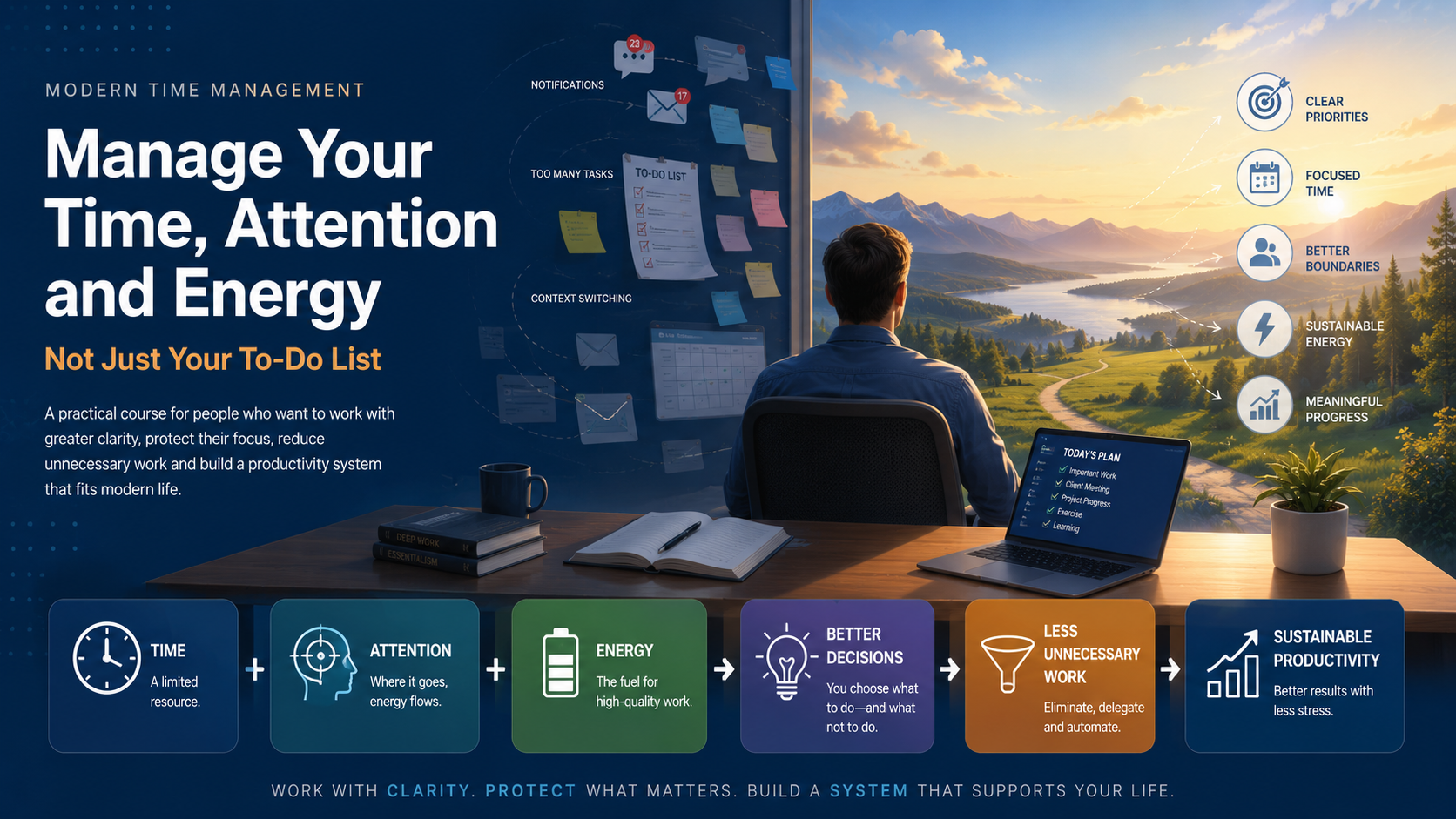
MODERN TIME MANAGEMENT
Manage Your Time, Attention and Energy — Not Just Your To-Do List
A practical course for people who want to work with greater clarity, protect their focus, reduce unnecessary work and build a productivity system that fits modern life.
6
Modules
40
Practical Chapters
Modern
Work Practices
AI + Automation
Included
WHY TIME MANAGEMENT NEEDS A MODERN APPROACH
The Problem Is No Longer Just a Lack of Time
You may have a calendar, a task manager and a long list of things to do — and still finish the day wondering where your time went.
Modern work creates a different productivity challenge. Messages arrive continuously. Meetings compete with focused work. Digital tools make interruption effortless. Remote and hybrid work blur boundaries. AI can save time, but it can also create more information and more decisions.
Effective time management therefore requires more than scheduling tasks.
You need to manage time, attention, energy, commitments, communication and the systems around your work.
WHAT YOU WILL LEARN
Build a System That Helps Important Work Actually Happen
01
Choose What Deserves Your Time
Clarify priorities, roles and goals so that your calendar reflects what actually matters.
02
Plan Realistically
Turn priorities into weekly and daily plans without filling every available minute.
03
Protect Focus
Reduce interruptions, context switching and digital distraction so demanding work receives real attention.
04
Work Better with Other People
Improve meetings, communication, delegation, boundaries and team time management.
05
Protect Sustainable Capacity
Manage energy, recovery, stress and workload instead of financing productivity with evenings and exhaustion.
06
Use AI and Automation Intelligently
Reduce repetitive work and use modern tools where they save real time rather than creating more complexity.
THE COURSE
40 Chapters. Six Connected Modules.
The course moves from the foundations of personal time management to modern digital productivity, AI, automation and a complete personal productivity system.
MODULE 1
Foundations: What Deserves Your Time?
Time value, priorities, roles, goals, long-term planning, urgency and time auditing.
Chapters 1–8
MODULE 2
Planning and Controlling Your Work
Daily planning, peak performance, buffers, incoming tasks, saying no and delegation.
Chapters 9–15
MODULE 3
Communication, Collaboration and Boundaries
Communication, calls, meetings, interruptions, digital friction and protecting your availability.
Chapters 16–23
MODULE 4
Focus, Energy and Sustainable Performance
Motivation, concentration, rest, health, stress, burnout and conflict.
Chapters 24–29
MODULE 5
Modern Ways of Working
Remote and hybrid work, individual productivity styles and modern time-management tools.
Chapters 30–32
MODULE 6
Digital Productivity and AI
Digital attention, communication channels, AI, automation, knowledge management, disconnection and team productivity.
Chapters 33–40
HOW TO USE THE COURSE
Read. Apply. Improve.
1
Learn the Principle
Each chapter explains one practical part of modern time management in clear language.
2
Use the Exercises
Apply the ideas to your own calendar, tasks, communication, workload and working habits.
3
Build Your Own System
Keep what works, adjust what does not and gradually create a system that fits your real life.
MODERN PRODUCTIVITY
Time Management Is No Longer About Doing More Every Minute
Traditional productivity advice often asks how to fit more activity into the day.
Modern Time Management asks a broader set of questions:
- What deserves your time in the first place?
- What should you stop doing?
- What should be delegated?
- What can be automated?
- Where can AI reduce unnecessary effort?
- Which communication should remain asynchronous?
- When should you protect uninterrupted work?
- How do you preserve enough energy and recovery to keep performing tomorrow?
Good productivity is not maximum activity. It is deliberate use of limited time, attention and energy.
WHO IS THIS COURSE FOR?
For People Whose Work Competes for Their Attention
Professionals
Manage competing responsibilities, meetings, messages, deadlines and focused work.
Managers
Improve delegation, team time, meeting culture, availability and decision flow.
Entrepreneurs
Reduce unnecessary personal work and use systems, automation and AI more intelligently.
Students & Knowledge Workers
Protect concentration, organize complex work and make consistent progress on long-term projects.
PRACTICAL BY DESIGN
Not Another Collection of Productivity Tips
- Clear explanations
- Realistic examples
- Practical exercises
- Visual frameworks
- Modern digital work
- AI and automation
- Remote and hybrid work
- Sustainable performance
You do not need to adopt every technique. The course helps you identify the problems in your current system and choose the methods that solve them.
BUILD YOUR SYSTEM
Stop Managing Every Day from Scratch
Build a system that helps you decide what matters, protect time for it, reduce unnecessary work and adapt when reality changes.