How to Improve Time Management Skills: 10 Practical Steps
How to Improve Time Management Skills: 10 Practical Steps
Learning to improve time management skills starts with changing the way you choose, plan, and protect your work—not with trying to make every minute busy. The most reliable approach combines clear priorities, realistic scheduling, focused work, and a short review routine.

If your days feel reactive, you do not need a complicated productivity system. You need a few useful time management habits that reveal what matters, make your capacity visible, and help you adjust before a deadline becomes a crisis.
This practical guide explains how to improve time management skills step by step. You can use the process at work, while studying, in a small business, or whenever several responsibilities compete for limited time.
Start With the Right Definition of Better Time Management
Better time management does not mean completing the largest possible number of tasks. It means using available time in a way that supports important results, reasonable commitments, and personal well-being. Sometimes the best decision is to finish a task. At other times, it is to delay, delegate, simplify, or decline it.
Before changing your routine, review what time management is. Then assess the specific abilities described in our guide to essential time management skills. This makes it easier to improve the part of your system that is actually failing.
For example, a missed deadline may look like a motivation problem. However, the real cause could be an unrealistic estimate, an unclear next action, competing priorities, or interruptions that were never included in the plan.
Improve Time Management Skills in 10 Practical Steps
1. Track one normal week
To improve time management skills, begin with evidence. For five to seven days, record your main activities, interruptions, unfinished tasks, and the difference between planned and actual time. Use broad categories rather than tracking every minute.
At the end of the week, look for repeated patterns. Do messages consume the first hour of the day? Do meetings create follow-up work that was not scheduled? Are large tasks repeatedly moved because their next step is unclear? Observation turns a vague sense of being busy into a problem you can solve.
2. Define three meaningful outcomes
A long task list does not show what matters most. Choose up to three meaningful outcomes for the day. An outcome describes a useful result, such as “send the reviewed proposal,” rather than an activity such as “work on proposal.”
This simple practice helps you improve time management skills by strengthening task prioritization. It also gives you a clear test when new requests appear: will this request replace one of the three outcomes, or can it wait?
3. Break work into visible next actions
Large or ambiguous tasks invite delay. “Prepare the presentation” may contain research, an outline, data gathering, slide design, review, and rehearsal. Identify the next action that can be completed in one work session.
Clear next actions improve time management skills because they are easier to estimate and schedule. They also reduce the mental effort required to begin.
4. Estimate time with a buffer
Better planning skills require honest estimates. Include preparation, communication, review, and switching time—not just the central task. If similar work usually takes 45 minutes, reserving exactly 45 minutes leaves no room for normal variation.
If you want to improve time management skills, add a modest buffer, especially for unfamiliar or collaborative work. Then compare the estimate with the actual duration. Over several weeks, this feedback makes your future plans more accurate.
5. Use time blocks for important work
A task list records commitments, while a calendar shows capacity. Place important work into specific time blocks before the week fills with lower-value activity. Define the intended result for each block and protect it like a meeting.
Time blocking can improve time management skills, but it is not a promise that the day will unfold perfectly. It is a visible plan that makes trade-offs easier. When something changes, move or resize the block instead of silently abandoning the work.
6. Reduce attention switching
You cannot improve time management skills while attention is continuously redirected. Silence nonessential notifications, close unrelated tabs, and group routine communication into one or two sessions when your role allows it.
For demanding work, choose a focus period that matches your energy and environment. A useful session may be 25, 45, or 90 minutes. The exact number matters less than staying with one meaningful task.
7. Create rules for recurring decisions
Repeated decisions consume time and mental energy. Create simple rules for routine situations: meetings need a purpose and agenda; tasks with no deadline enter a review list; requests that take less than two minutes are handled during an administration block; new commitments are checked against current capacity.
These rules improve time management skills by becoming dependable time management habits. They reduce hesitation and prevent noisy requests from automatically receiving priority.
8. Set boundaries and communicate early
Time management is often a communication problem. If your capacity is full, explain what can be completed, what would need to move, and when a realistic delivery is possible. Raise risks before the final day.
A clear boundary protects both focus and trust. “I can deliver this on Thursday, or I can pause the report and deliver it tomorrow” is more useful than agreeing to both and missing one.
9. Delegate outcomes, not fragments
If another person can own appropriate work, define the expected result, available resources, deadline, and check-in point. Avoid delegating tiny disconnected fragments that require constant coordination.
Good delegation improves time management skills across a team because it distributes responsibility without creating ambiguity. It also protects a manager from becoming the bottleneck for every decision.
10. Review and adjust every week
A weekly review turns experience into better time management. Check completed work, unfinished commitments, upcoming deadlines, and tasks that repeatedly took longer than expected. Decide what to keep, change, postpone, or remove.
Finally, choose one adjustment for the next week. Small experiments are easier to sustain than a complete system rebuild.
Build Planning Skills With a Simple Weekly System
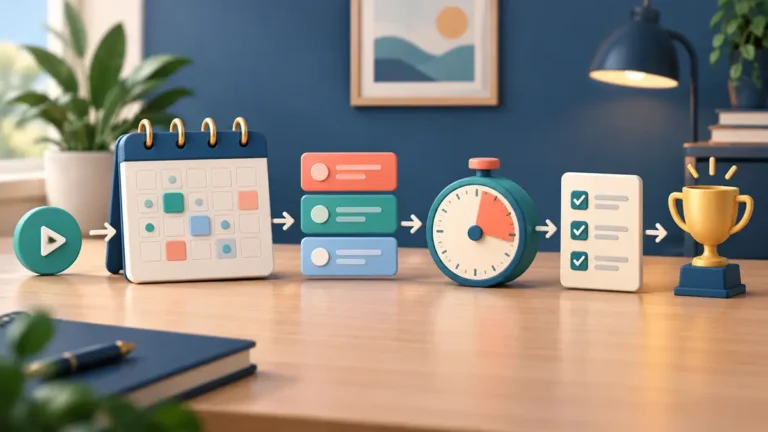
You can improve time management skills with three connected views: a master list, a weekly plan, and a daily focus list. The master list stores commitments. The weekly plan reserves time for important outcomes. The daily list identifies the few results that deserve attention now.
Use the following weekly sequence:
- Review deadlines, meetings, and outstanding commitments.
- Select the week’s most important outcomes.
- Break each outcome into a visible next action.
- Estimate the required time and add a realistic buffer.
- Reserve focus blocks before filling remaining space.
- Leave open capacity for routine work and surprises.
- Review the plan briefly at the end of each day.
This system supports planning skills without requiring you to schedule every minute. Moreover, it creates a bridge between long-term priorities and the next action on your screen.
Time Management Habits That Make Improvement Sustainable
Useful systems depend on small behaviors that can survive a busy week. Choose habits with a clear cue and a visible action. For example: after the final meeting on Friday, review unfinished tasks for 15 minutes; before opening email, identify the day’s top outcome; after accepting a deadline, reserve the work in the calendar.
Do not add five new habits at once. Select one that addresses the most expensive recurring problem. Practice it until it feels normal, then add another. Consistency creates better time management more reliably than occasional bursts of organization.
Keep tools simple as well. A calendar, a trusted task list, and a place for notes are enough for many people. Changing applications does not improve time management skills unless the underlying decision or behavior also changes.
Common Obstacles and How to Handle Them
- Everything feels urgent: compare impact, deadline, dependency, and cost of delay. Ask which task should move when a new urgent request appears.
- Plans are always too full: use actual durations, add buffers, and schedule only part of your total capacity.
- You procrastinate on large work: define a next action small enough for one session and reserve a clear starting time.
- Messages interrupt focus: create communication windows and publish your expected response time when possible.
- Priorities change: keep open capacity and update the visible plan instead of treating the original plan as a failure.
- You forget tasks: capture commitments in one trusted place and review it daily.
Recognizing these obstacles helps you improve time management skills. They are normal. The goal is not to eliminate change but to recover quickly when change occurs.
How to Measure Better Time Management
Measure outcomes that matter instead of counting how busy you were. Useful indicators include the percentage of important tasks finished by their deadline, the amount of focused time protected, the accuracy of estimates, the number of overdue commitments, and your level of end-of-day stress.
To improve time management skills with evidence, choose two or three indicators and review them weekly. If focused time increases but important deadlines are still missed, prioritization may need work. If plans are completed but stress remains high, your workload or recovery may require attention.
Remember why time management is important: the purpose is not merely efficiency. Better time management should support useful progress, clearer expectations, and a more sustainable way of working.
A 30-Day Plan to Improve Time Management Skills
Week 1: Track time and identify one recurring breakdown. Do not redesign your whole system yet.
Week 2: Choose daily outcomes, define next actions, and estimate work with a buffer.
Week 3: Add calendar blocks for important work and reduce one major source of interruption.
Week 4: Complete a weekly review, compare planned and actual results, and decide which habit to keep.
After 30 days, repeat the cycle with the next most important weakness. This focused approach helps you improve time management skills while keeping the change realistic.
Frequently Asked Questions
How long does it take to improve time management skills?
You can notice useful changes within a week, especially from clearer priorities and realistic planning. Reliable time management habits usually require several weeks of repetition and review.
What should I improve first?
Start with the point where your current system breaks most often. If important work is postponed, improve prioritization. If plans overflow, improve estimation. If progress is fragmented, protect focus.
Which tool is best for better time management?
The best tool is one you will review consistently. A simple calendar and task list are often sufficient. Choose tools only after you understand the behavior they need to support.
Can I improve time management skills in a changing job?
Yes. Use shorter planning cycles, protect some open capacity, and review priorities whenever new work arrives. Adaptability is part of effective time management, not evidence that planning failed.
Final Thoughts
To improve time management skills, start with one week of observation, choose meaningful outcomes, define next actions, estimate honestly, protect focus, communicate boundaries, and review the results. These practical planning skills create a system that can respond to change without losing sight of important work.
Choose one of these time management habits today. Apply it for a week, measure what changes, and adjust. Better time management is built through small, informed decisions repeated consistently.