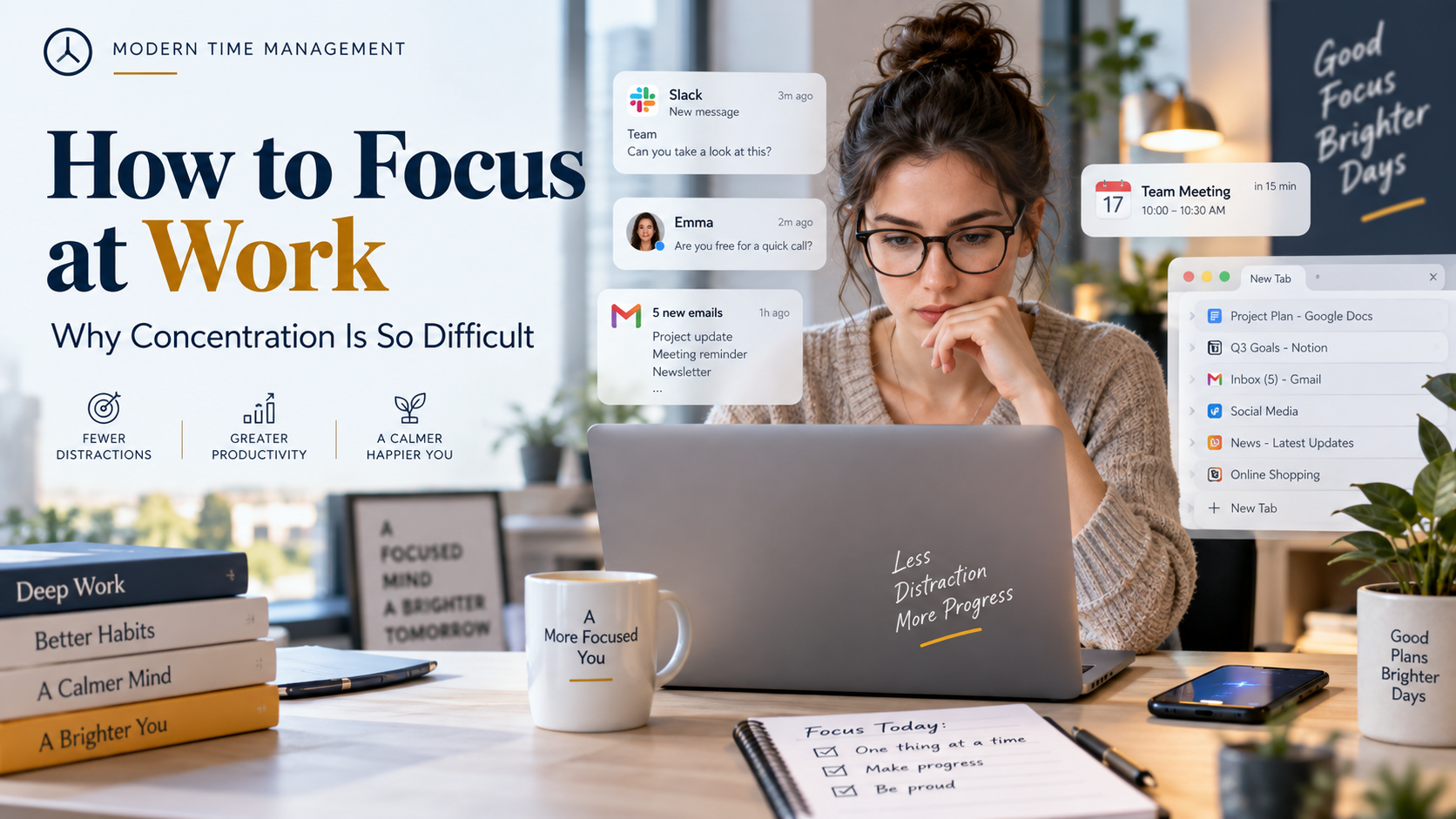
How to Focus at Work: Why Concentration Is So Difficult
How to Focus at Work: Why Concentration Is So Difficult
If you are wondering how to focus at work, the obvious assumption is that you need better discipline.
Maybe you should check your phone less.
Maybe you need more motivation.
Maybe you simply need to concentrate harder.
But modern work makes concentration surprisingly difficult even for people who genuinely want to focus.
A working day can contain emails, messaging apps, meetings, browser tabs, notifications, colleagues, phone calls, administrative tasks and dozens of tiny decisions.
None of these activities seems particularly destructive on its own.
Together, they can leave surprisingly little uninterrupted attention for the work you were actually hired to do.
That is why difficulty focusing at work does not always look like obvious distraction.
Sometimes it looks like an extremely busy and respectable working day.
Why Is It So Hard to Focus at Work?
A typical office worker may begin the morning with a simple intention:
Finish an important task.
Then the inbox opens.
A colleague asks a question.
A meeting starts.
Someone sends a link.
Another message appears.
You remember something else that needs checking.
Lunch arrives.
By mid-afternoon, you have done many things.
But the original task is still waiting.
This is one of the strange characteristics of modern work:
You can spend an entire day working without spending much of the day on the work that requires real concentration.
Why Being Busy Makes It Hard to Focus at Work
A focus problem does not necessarily mean staring out of the window for three hours.
It can look much more productive.
You answer emails.
You attend meetings.
You update documents.
You respond to messages.
You move tasks around.
You check numbers.
You approve things.
You make calls.
At 17:00, you have completed dozens of actions.
But the difficult report, analysis, proposal or creative task has barely moved.
Busy work is dangerous because it produces visible evidence of effort.
Concentrated work often produces fewer visible actions.
One hour may produce only a few paragraphs, one decision or one difficult solution.
That can make fragmented work feel more productive than focused work even when the opposite is true.
The Two-Minute Interruption That Does Not Really Last Two Minutes
Suppose you are writing something difficult.
A message appears.
You spend two minutes replying.
Technically, the interruption lasted two minutes.
But the real cost may be larger.
You need to remember what you were doing.
Where was the argument going?
Which figure were you checking?
What sentence were you trying to write?
The interruption may be over, but part of your attention is still elsewhere.
This is why a day containing dozens of small interruptions can feel surprisingly exhausting.
No single interruption seems serious enough to blame.
The accumulation is the problem.
The Notification That You Do Not Even Open
Notifications can affect concentration even when you ignore them.
The screen flashes.
You see the sender’s name.
You do not open the message.
But now you know it exists.
Was it important?
Should you answer?
What does the preview mean?
A small piece of unfinished business has entered your mind.
You may continue working, but your attention is no longer exactly where it was before.
The notification succeeded without you clicking anything.
How Workplace Distractions Make It Hard to Focus at Work
This makes workplace distractions different from many personal distractions.
Scrolling social media during a report is easy to identify as distraction.
Answering a colleague is more complicated.
So is checking an important email.
Or attending a meeting.
Or responding to a customer.
These are legitimate parts of many jobs.
The problem is that legitimate work can still fragment concentration.
A distraction does not need to be pointless to interrupt you.
Email Is Both Work and Interruption
Email occupies a strange position in modern work.
It is a genuine communication tool.
It is also an almost endless stream of new tasks.
Opening an inbox means exposing yourself to:
- new questions;
- requests;
- problems;
- deadlines;
- documents;
- information;
- other people’s priorities.
You may open email intending to check one message and leave 25 minutes later with three new tasks and a completely different mental agenda.
Nothing recreational happened.
You were working the entire time.
Your focus still disappeared.
Chat Apps Made Interruption Faster
Email at least carries a small amount of delay.
Workplace messaging often feels immediate.
A green status indicator tells other people you are available.
Someone asks a quick question.
You answer quickly.
Then another person asks something.
The attraction is obvious: problems can be solved immediately.
But immediate communication can gradually create an environment where waiting becomes abnormal.
A five-minute delay begins to feel slow.
Then concentration starts competing with the expectation of constant availability.
The Open Tab Problem
Browser tabs are tiny reminders of unfinished intentions.
One tab contains research.
Another contains email.
Another has a document.
Another is something you want to read later.
Another is an analytics dashboard.
Another contains a product you might buy.
Another has no obvious purpose, but you are afraid to close it.
Each tab may represent a potential task.
A browser containing 37 tabs can become a visual version of an overloaded mind.
You do not need to click them for them to remind you that other things exist.
Why Starting Is Sometimes Harder Than Continuing
People often describe difficulty concentrating as an inability to stay focused.
But another problem occurs before concentration even begins.
You have 30 minutes before a meeting.
Is it worth starting?
Probably not, you think.
So you check email.
After the meeting, there are 25 minutes before lunch.
Again, it feels too short.
Then another meeting begins at 14:00.
Soon the day contains many fragments that never feel large enough for demanding work.
Nothing necessarily interrupted the task because the task never truly started.
Why Meetings Make It Hard to Focus at Work
A one-hour meeting does not always consume only one hour.
Imagine meetings at:
10:00
13:00
15:30
There may still be several hours available.
On paper, the schedule looks reasonable.
In practice, the day can feel fragmented.
Before each meeting, there may be too little time to start something difficult.
After the meeting, you may need to process what happened.
Then another commitment approaches.
A few meetings distributed across the day can therefore shape much more time than their actual duration suggests.
The Strange Problem of the 30-Minute Gap
Thirty minutes is plenty of time for some activities.
It can feel almost useless for others.
If a demanding task requires mental setup, a 30-minute gap may be psychologically difficult to use.
You know that just as you begin to understand the problem, you will need to stop.
So the gap gets filled with smaller tasks.
This is one reason calendars can appear to contain plenty of free time while workers still feel they have no time to concentrate.
“I’ll Do the Real Work After the Meetings”
This sentence is common.
It often becomes:
“I’ll do it after lunch.”
Then:
“I’ll do it once I clear these emails.”
Then:
“I’ll start first thing tomorrow.”
The interesting part is that the person may have worked hard all day.
The focused task has simply been displaced by activities with stronger immediate signals.
Why Difficult Tasks Make It Hard to Focus at Work
Not all distraction comes from outside.
Difficult work creates its own temptation to escape.
A confusing paragraph.
A complicated spreadsheet.
An uncertain decision.
A blank presentation.
Suddenly checking email seems unusually attractive.
The inbox offers something difficult work does not:
Clear events.
A message arrives.
You answer it.
Done.
Complex work often has no such immediate reward.
You may spend 40 minutes thinking and still feel unsure whether progress occurred.
That makes simpler tasks psychologically appealing.
The Productivity Value of Feeling Finished
Small work produces frequent completion.
Send message.
Done.
Approve document.
Done.
Reply to email.
Done.
Update spreadsheet.
Done.
Focused work can take hours before anything feels finished.
This difference matters because completed tasks provide satisfaction.
A person can therefore drift toward low-complexity activities without consciously deciding to avoid important work.
The day becomes optimized for finishing things rather than advancing things.
Why Your Phone Is Not the Only Problem
Phones receive enormous attention in discussions about concentration.
They certainly can be distracting.
But removing your phone will not fix:
- unnecessary meetings;
- unclear priorities;
- constant work messages;
- overloaded schedules;
- noisy environments;
- unclear tasks;
- excessive email;
- fragmented calendars.
Sometimes the smartphone becomes an easy villain because it is visible.
The larger workplace environment is harder to change.
The “Always Available” Employee
Some employees develop a reputation for responding immediately.
A message arrives at 09:14.
The reply comes at 09:15.
Another arrives at 09:22.
Reply at 09:23.
This can look highly professional.
But there is a hidden trade-off.
A person who is permanently available for interruption may struggle to protect attention for work that cannot be completed in one-minute fragments.
Responsiveness and concentration sometimes compete.
Workplaces do not always acknowledge this conflict.
Why Remote Work Can Make It Hard to Focus at Work
Working from home eliminated some office interruptions.
It introduced others.
Laundry exists.
Food exists.
Family members exist.
Delivery drivers arrive.
The entire internet is one browser tab away.
And because remote workers are less physically visible, digital responsiveness can become even more important as evidence of availability.
The office door disappeared.
The green status indicator replaced it.
Office Work Has Its Own Attention Tax
In an office, distraction can come from simple visibility.
A colleague walks past.
Someone begins a conversation nearby.
A phone rings.
Two people discuss something interesting.
Someone asks a quick question.
Nothing dramatic occurs.
But attention repeatedly notices the environment.
Open offices can make this especially noticeable because the brain is surrounded by information that may or may not matter.
Noise Is Not Always the Main Problem
Some people can work effectively in a noisy café but struggle in a relatively quiet office.
Why?
Predictability may matter.
Background noise from strangers often has nothing to do with you.
Conversation between colleagues may contain your name, your project or information that might require action.
Your attention has a reason to monitor it.
The sound becomes harder to ignore because it might matter.
Difficulty Concentrating at Work Can Be Task-Specific
You may have no trouble concentrating on one activity and enormous difficulty with another.
This suggests that the problem is not always general attention.
A task may be:
- poorly defined;
- unusually difficult;
- emotionally uncomfortable;
- repetitive;
- ambiguous;
- dependent on missing information.
“Can’t focus” can sometimes mean “I do not know exactly what to do next.”
Those are different problems.
The Vague Task Problem
Consider a task called:
Work on strategy.
What should you actually do?
Read something?
Write something?
Make a decision?
Analyze data?
Talk to someone?
The task has no obvious first action.
That ambiguity creates friction.
It becomes easy to postpone because there is no clear moment when work has actually begun.
Meanwhile, email offers dozens of clearly defined next steps.
Why Too Many Priorities Make It Hard to Focus at Work
If five tasks are equally urgent, deciding where to focus becomes difficult.
You begin one.
Then remember another.
Switch.
Then wonder whether the third is more important.
Switch again.
From the outside, this looks like poor concentration.
But the underlying problem may be unresolved priorities.
Attention cannot settle because the decision about what deserves attention has never really been made.
The Tab-Switching Working Style
Some people spend the day switching rapidly:
Spreadsheet.
Email.
Document.
Chat.
Browser.
Spreadsheet.
Calendar.
Chat.
Document.
This can become so normal that continuous work on one thing begins to feel uncomfortable.
The brain becomes accustomed to novelty.
A quiet document containing one difficult problem feels almost unnaturally slow.
Constant switching is not merely something technology does to us.
It can also become a learned working style.
Why Silence Can Feel Unproductive
A person thinking deeply may appear to be doing nothing.
There are no keystrokes.
No emails are being sent.
No messages appear.
Someone simply looks at a screen or notebook.
Modern work environments often reward visible activity.
That can encourage constant action even when thinking would be more valuable.
Focus sometimes looks suspiciously similar to inactivity.
The End-of-Day Mystery
One common experience captures the entire problem:
“I worked all day. What did I actually do?”
This does not necessarily mean nothing was accomplished.
Many legitimate activities happened.
The problem is that fragmented work leaves fewer memorable milestones.
A completed major task is easy to remember.
Forty-five tiny interactions blur together.
The day felt full while the outcome feels strangely difficult to describe.
Why Trying Harder May Not Help You Focus at Work
If concentration difficulties come from a fragmented work environment, telling yourself to “focus harder” has limited value.
Attention is being repeatedly asked to respond to competing signals.
Personal effort can help, but it does not make meetings disappear, clarify vague tasks or reduce an overloaded inbox.
This is why concentration should not always be treated purely as a character trait.
Sometimes it is a consequence of how work is organized.
Signs Your Workday May Be Too Fragmented
You may recognize several of these patterns:
- you rarely work on one thing for long;
- email stays open all day;
- messages are answered almost immediately;
- meetings divide the day into small gaps;
- your most important work starts late;
- you regularly switch tabs without finishing anything;
- you feel busy but struggle to name major accomplishments;
- difficult work keeps moving to tomorrow;
- you are tired despite completing mostly small tasks;
- you need evenings to finish work that required concentration.
None of these individually proves a focus problem.
Together, they can reveal an environment where concentration has very little room to occur.
Is Multitasking the Real Problem?
People often describe themselves as multitasking.
In many cases, they are actually switching rapidly between tasks.
The distinction may sound technical, but the lived experience is familiar.
Write two sentences.
Answer message.
Return to document.
Check spreadsheet.
Reply to email.
Return again.
The work is not happening simultaneously.
Attention is moving.
The day becomes a sequence of partial engagements.
Can Productivity Tools Make Focus Worse?
Ironically, yes.
A productivity system may create additional surfaces demanding attention.
Task manager.
Calendar.
Project dashboard.
Team chat.
Email.
Notes app.
Habit tracker.
Analytics.
Each tool may be useful individually.
Together, they can create another layer of things to monitor.
More organization does not automatically mean less cognitive clutter.
What to Notice Before Learning How to Focus at Work
Before looking for another productivity technique, it may be more useful to observe what your workday actually looks like.
When does focused work usually disappear?
What interrupts it?
Which meetings fragment the day?
Which tasks are repeatedly postponed?
How often does communication cause task switching?
Which work feels unusually difficult to start?
This article deliberately stops short of giving you a complete focus system.
The important first insight is simpler:
A concentration problem may be far more structural than it appears.
Frequently Asked Questions About How to Focus at Work
Why can’t I focus at work?
Difficulty focusing at work can be caused by interruptions, meetings, notifications, unclear tasks, competing priorities, email, messaging apps and frequent switching between different kinds of work.
Why do I lose focus so quickly at work?
Your attention may be repeatedly responding to incoming information. Even short interruptions can make continuous concentration difficult when they happen frequently.
Why am I busy all day but get nothing done?
You may be completing many small or reactive tasks while larger, concentration-heavy work receives little uninterrupted time.
Do meetings reduce focus?
Meetings can affect more than their scheduled duration by dividing the day into shorter periods that may be difficult to use for demanding work.
Why is email so distracting at work?
Email combines communication with a continuous stream of new requests, decisions and potential tasks, making it easy for other people’s priorities to replace your current work.
Does working from home improve focus?
It can remove some office distractions but introduce different ones, including household interruptions and stronger reliance on digital communication.
Final Thoughts on How to Focus at Work
If you are searching for how to focus at work, it may be worth questioning the assumption that concentration is simply something you either have or lack.
Modern work constantly competes for attention.
Messages are legitimate work.
Emails are legitimate work.
Meetings are legitimate work.
Small requests are legitimate work.
And yet the combination can create a working day where there is remarkably little room left for sustained concentration.
The person experiencing the problem may conclude:
“I need to focus better.”
But another question may be more revealing:
“How much of my working day actually allows focus to happen?”
That question takes us beyond discipline and into the structure of work itself.
For related reading, continue with Overplanning Your Day: Why Too Much Planning Backfires, How to Prioritize Tasks, and How to Estimate Task Duration More Accurately.