What Is Time Management? A Practical Guide
Time management is the process of deciding how to use your available time so that important tasks get done without unnecessary stress, delay, or wasted effort.
It sounds simple, but good time management involves more than creating a schedule or writing a to-do list. It requires you to decide what deserves your attention, estimate how long activities will take, organize your workload, protect time for important work, and adjust when plans change.
In modern life, time management has also become closely connected with attention management. You may have enough hours in the day, but constant notifications, emails, meetings, interruptions, and competing priorities can make those hours difficult to use effectively.
This guide explains what time management means, why it matters, which skills are involved, and how you can start improving the way you use your time.
What Is Time Management?
Time management is the deliberate organization of your time around tasks, responsibilities, priorities, and goals.
At its most basic level, time management answers four questions:
- What needs to be done?
- What should be done first?
- When should it be done?
- How much time should be allocated to it?
Effective time management does not mean filling every available minute with work. The goal is not to become constantly busy.
Instead, good time management helps you use time more intentionally.
A person with strong time management skills may sometimes choose to work less, postpone a low-priority task, decline a meeting, or leave unused space in their calendar. These decisions can be just as important as completing more tasks.
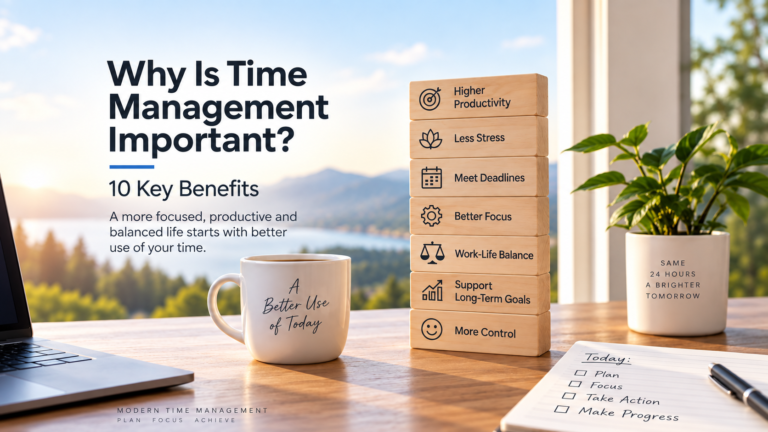
Why Is Time Management Important?
Time is a limited resource. Everyone has the same 24 hours in a day, but people differ greatly in how much useful work, rest, learning, and personal activity they manage to fit into those hours.
Poor time management can lead to:
- missed deadlines;
- rushed work;
- unfinished tasks;
- excessive overtime;
- forgotten commitments;
- constant feelings of urgency;
- difficulty concentrating;
- unnecessary stress.
Better time management can make your workload feel more manageable because you have a clearer idea of what needs your attention and when.
It can also help you avoid spending large amounts of time on activities that feel productive but contribute little to your actual goals.
Time Management Is Not About Doing More
One of the biggest misunderstandings about time management is that its purpose is to help you fit more activities into every day.
That is not necessarily true.
Imagine that you complete 15 small tasks during the day but make no progress on the one project that actually matters. You have been busy, but your time management may still have been poor.
A more effective approach might involve completing only five tasks, with one of them being the most important task of the week.
Good time management therefore requires both efficiency and prioritization.
Efficiency means using your time well.
Prioritization means using your time on the right things.
You need both.
The Main Time Management Skills
Time management is not one individual skill. It is a combination of several abilities.
1. Prioritization
Prioritization means identifying which tasks deserve your attention first.
Not every task has equal importance. Some activities contribute directly to important goals, while others are routine, optional, or can be delayed.
Without clear priorities, people often work on whatever appears most urgent or easiest to complete.
2. Planning
Planning involves deciding in advance how you intend to use your time.
This might include daily planning, weekly planning, calendar scheduling, project planning, or creating task lists.
The purpose of planning is not to predict every minute perfectly. It is to reduce uncertainty and give important work a realistic place in your schedule.
3. Time Estimation
Many schedules fail because people underestimate how long tasks will take.
A task that appears to require 30 minutes may actually take an hour once preparation, interruptions, communication, and unexpected problems are included.
Improving your ability to estimate task duration makes planning more realistic.
4. Focus
Having time available does not automatically mean that you can use it effectively.
You also need enough uninterrupted attention to perform demanding work.
Good time management therefore includes reducing distractions, controlling interruptions, and creating periods when you can concentrate on one important activity.
5. Decision-Making
Every day contains small decisions about time.
Should you answer this email now?
Should you attend that meeting?
Should you finish one task before starting another?
Should you accept another responsibility?
Time management improves when these decisions are made consciously rather than automatically.
6. Flexibility
Even a well-designed schedule will occasionally fail.
Tasks take longer than expected. New responsibilities appear. Meetings move. Technical problems occur.
Effective time management requires the ability to change your plan without abandoning it completely.
What Does Good Time Management Look Like?
Good time management does not look exactly the same for everyone.
A student may need to balance lectures, assignments, study time, work, and personal commitments.
A manager may spend much of the day dealing with meetings, decisions, employees, and unexpected problems.
A freelancer may have more control over the schedule but must manage multiple projects and deadlines independently.
However, good time management usually has several common characteristics.
You know your most important priorities.
You have a realistic idea of what can be completed during the day.
Important work has dedicated time.
Your schedule contains some flexibility.
You are not constantly reacting to every new request.
You regularly review unfinished tasks and upcoming commitments.
And perhaps most importantly, your system helps you make decisions instead of creating additional work.
Common Time Management Problems
Most people do not struggle with time management because they have never heard of calendars or to-do lists.
The difficulties are usually more practical.
Trying to Do Too Much
A common problem is planning more work than can realistically fit into the available time.
When this happens every day, unfinished tasks accumulate and the to-do list becomes increasingly difficult to manage.
Treating Everything as Important
If every task is a priority, then nothing is really a priority.
Some tasks must be completed immediately. Others can wait.
Learning to distinguish between them is an essential part of time management.
Constant Interruptions
Emails, instant messages, phone notifications, colleagues, and meetings can divide the working day into small fragments.
Even when each interruption takes only a few minutes, repeatedly switching between tasks can make concentrated work difficult.
Procrastination
Sometimes people know exactly what they need to do but continue postponing it.
Procrastination can be connected with difficult, unclear, boring, or uncomfortable tasks.
Better planning can help, but procrastination also requires understanding why a particular task is being avoided.
Overcomplicated Productivity Systems
Another problem is spending too much time managing the system itself.
A productivity method should reduce complexity.
If you constantly reorganize task lists, change apps, create categories, or redesign schedules, the system may be consuming time rather than saving it.
How to Improve Your Time Management
You do not need to rebuild your entire life to start managing time better.
A few basic changes can make a noticeable difference.
Choose Your Most Important Tasks
At the beginning of the day or week, identify the tasks that matter most.
Ask yourself:
If I cannot complete everything, which tasks would I most regret leaving unfinished?
Start there.
Plan Less Than 100% of Your Available Time
Unexpected events are normal.
If every hour of your day is already allocated, even a small delay can destroy the entire schedule.
Leave some flexibility for interruptions, delays, and tasks that take longer than expected.
Estimate Tasks Realistically
Before scheduling a task, consider how long similar work has taken in the past.
Do not base your schedule only on the fastest possible completion time.
Reduce Unnecessary Switching
Where possible, group similar activities together.
For example, dealing with several emails at once may be more efficient than checking your inbox every few minutes throughout the day.
Review Your Day
At the end of the day, briefly look at what happened.
What did you complete?
What remained unfinished?
What took longer than expected?
What interrupted your work?
This information can help you create better plans in the future.
Time Management vs Productivity
Time management and productivity are closely related, but they are not identical.
Time management concerns how you allocate and organize your time.
Productivity concerns the useful results produced from your effort and resources.
You can manage your calendar perfectly and still spend your time on low-value work.
You can also be highly productive for a short period while having an unsustainable schedule.
The most effective approach combines good time management with clear priorities and realistic expectations.
Can Technology Improve Time Management?
Technology can help, but it can also create additional distractions.
Calendars, task managers, reminders, automation tools, and artificial intelligence can reduce administrative work and make planning easier.
However, no productivity tool can decide your priorities for you.
Using five planning apps will not solve the problem if you are trying to complete 15 hours of work in an eight-hour day.
The best tools are usually the ones that simplify your system rather than make it more complicated.
Does Everyone Need the Same Time Management System?
No.
There is no single time management method that works equally well for every person, profession, or lifestyle.
Some people prefer detailed calendars.
Others prefer flexible task lists.
Some jobs allow long periods of uninterrupted concentration, while others involve constant interaction and unexpected events.
The goal is therefore not to copy someone else’s perfect daily routine.
The goal is to develop a system that helps you make better decisions with the time available to you.
Final Thoughts
Time management is not about controlling every minute of your life.
It is about making better decisions about limited time.
Good time management helps you identify what matters, plan realistically, reduce unnecessary distractions, complete important tasks, and maintain enough flexibility for real life.
You do not need a complicated productivity system to begin.
Start by identifying your priorities, planning less than your full capacity, estimating tasks more realistically, and paying attention to where your time actually goes.
Small improvements in these areas can make your days more predictable, focused, and manageable.
And once the basics are working, you can begin building a more complete system for managing your time, attention, energy, and workload.