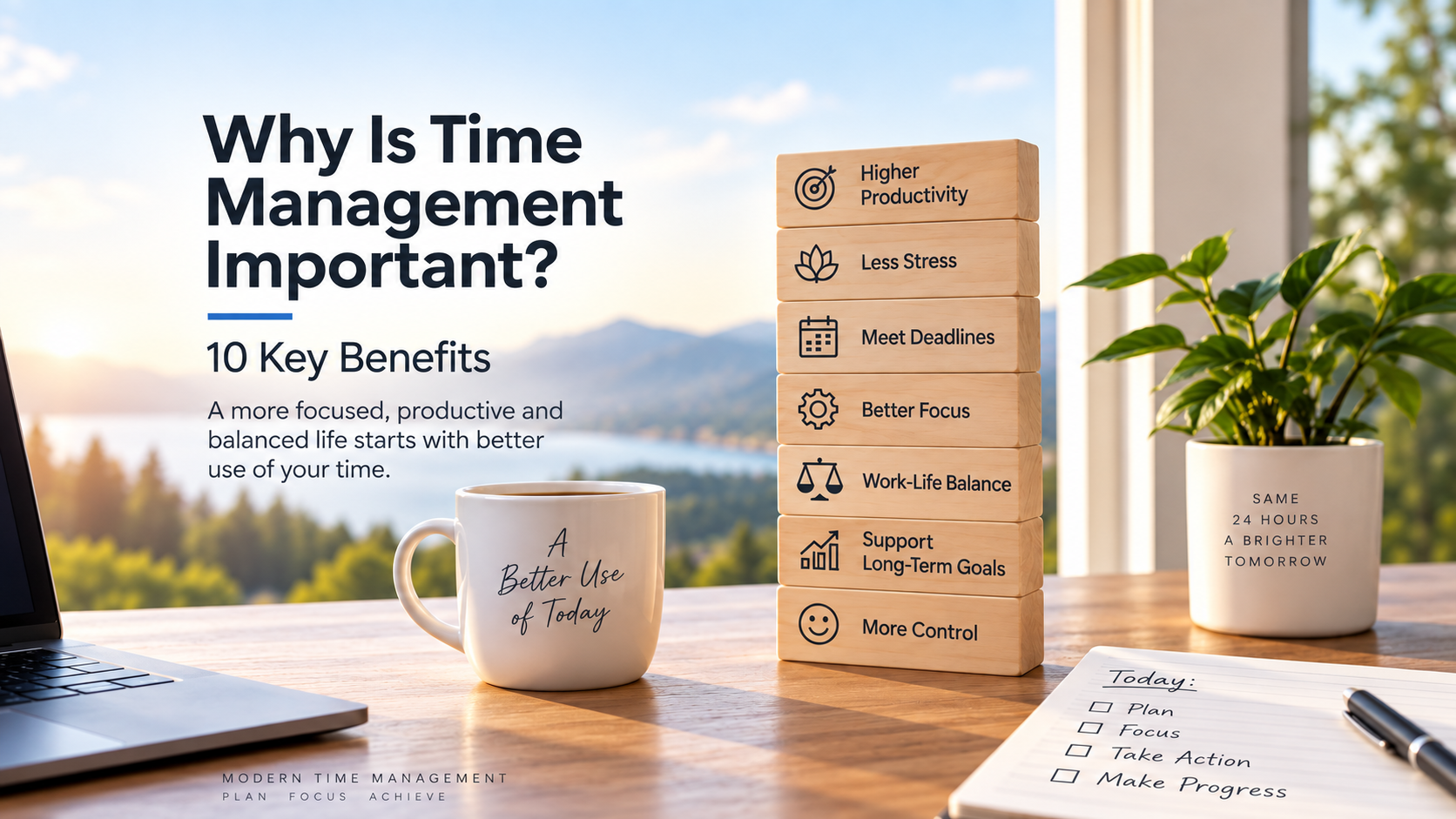
Why Is Time Management Important? 10 Key Benefits
Time management is important because it helps you use limited time more intentionally, complete important tasks, reduce unnecessary stress, and create a more realistic balance between work and personal life.
Without effective time management, even simple workloads can become difficult to control. Tasks accumulate, deadlines get closer, priorities become unclear, and much of the day can be spent reacting to problems instead of making progress.
Good time management does not mean working every minute of the day. It means making better decisions about what deserves your time, what can wait, and what may not need to be done at all.
In this guide, we look at why time management matters and the main benefits of improving the way you plan and use your time.
Why Is Time Management Important?
Time is different from most other resources because it cannot be stored or recovered.
Once an hour has passed, you cannot use it again.
This makes time management important in almost every area of life, including work, study, business, family responsibilities, and personal goals.
Effective time management can help you:
- focus on important tasks;
- meet deadlines;
- reduce procrastination;
- avoid unnecessary stress;
- improve productivity;
- create more predictable workdays;
- reduce wasted time;
- make better decisions;
- protect time for rest and personal life.
The goal is not simply to complete more tasks.
The goal is to make sure that the tasks you complete are the ones that matter most.
1. Time Management Helps You Focus on Priorities
One of the biggest benefits of time management is improved prioritization.
Most people have more possible tasks than they can realistically complete in one day.
If you try to do everything, you may end up spending valuable time on activities that are easy or urgent but not particularly important.
Time management forces you to make choices.
You begin asking questions such as:
- Which task has the greatest impact?
- Which deadline is most important?
- Which task can wait?
- Which activity can be delegated or removed?
These decisions help prevent low-value work from consuming your entire day.
2. Better Time Management Can Reduce Stress
Poor time management often creates unnecessary pressure.
When tasks are delayed until the last possible moment, even manageable work can suddenly become stressful.
For example, imagine having one week to complete a report.
If you begin early and spread the work across several days, the task may feel relatively manageable.
If you begin the night before the deadline, the same report becomes urgent.
The amount of work has not changed.
The available time has.
Planning ahead can therefore reduce the number of avoidable emergencies in your schedule.
3. Time Management Helps You Meet Deadlines
Deadlines are easier to manage when large tasks are identified early and divided into smaller steps.
Without planning, it is easy to assume that there is still plenty of time.
Then other responsibilities appear, tasks take longer than expected, or unexpected problems occur.
Good time management helps you see deadlines before they become urgent.
It also encourages you to leave some extra time between completing the work and the final deadline.
That buffer can be valuable when something does not go according to plan.
4. Time Management Can Improve Productivity
Productivity is not simply about working faster.
It is about producing useful results with the resources available.
Good time management supports productivity because it helps reduce wasted effort.
For example, you may become more productive by:
- working on high-priority tasks first;
- grouping similar tasks together;
- reducing unnecessary interruptions;
- limiting time spent on low-value activities;
- setting realistic time limits;
- protecting periods for focused work.
The result is not necessarily a busier day.
It may actually be a simpler one.
5. Time Management Reduces Procrastination
Procrastination often becomes worse when tasks are large, unclear, or poorly scheduled.
A task such as:
Complete the project
can feel difficult to start.
A more specific plan may include:
- review project requirements;
- create an outline;
- collect necessary information;
- complete the first section;
- review the draft.
Smaller and more specific tasks are usually easier to begin.
Time management can therefore reduce procrastination by making the next action clearer.
However, planning alone will not eliminate every form of procrastination. Sometimes people delay tasks because they are difficult, boring, uncomfortable, or uncertain.
In those situations, understanding the reason for the delay is also important.
6. Time Management Creates More Control Over Your Day
Without a plan, the day can easily become reactive.
You answer emails.
You respond to messages.
You attend meetings.
You solve whatever problem appears next.
By the end of the day, you may have been busy for many hours without completing your most important work.
Time management helps you move from reaction to intention.
Instead of asking:
What should I do next?
every few minutes, you already have a general idea of where your attention should go.
This does not mean that your schedule must be rigid.
It simply means that your priorities have been decided before every new interruption appears.
7. Better Time Management Can Improve Work Quality
Rushing affects quality.
When there is not enough time to complete a task properly, people may skip checking their work, make avoidable mistakes, or accept the first solution that seems good enough.
Planning creates space for better work.
Starting earlier may allow time for:
- research;
- review;
- correction;
- discussion;
- revision.
The ability to complete work without constant deadline pressure can therefore improve both efficiency and quality.
8. Time Management Helps Create Work-Life Balance
Work can easily expand into the time available for it.
If there is no clear end to the working day, there is always another email to answer, another task to complete, or another problem to think about.
Effective time management can help establish boundaries.
Planning work realistically makes it easier to decide when enough has been done for the day.
It also allows you to deliberately reserve time for:
- family;
- exercise;
- hobbies;
- sleep;
- social activities;
- rest.
Personal time should not simply be whatever remains after work is finished.
It may need to be protected in the same way as professional commitments.
9. Time Management Improves Decision-Making
Every schedule is based on decisions.
Should you accept another task?
Should you attend a meeting?
Should you answer an email immediately?
Should you finish one project before starting another?
Should you spend two hours improving something that is already good enough?
People who manage their time effectively become more aware of the cost of these decisions.
Every new commitment uses time that could have been spent elsewhere.
Understanding this trade-off can make it easier to say no to unnecessary activities.
10. Time Management Helps You Reach Long-Term Goals
Long-term goals are rarely achieved in a single day.
They usually require repeated effort over weeks, months, or years.
The problem is that long-term goals often compete with urgent daily tasks.
Urgent activities demand immediate attention.
Long-term goals often do not.
This means important goals can be postponed indefinitely.
Time management helps protect regular time for activities that may not be urgent today but can produce significant results over time.
Examples might include:
- learning a new skill;
- completing a qualification;
- building a business;
- improving fitness;
- writing a book;
- developing a major project.
Progress usually comes from consistent time investment rather than occasional bursts of activity.
What Happens When Time Is Managed Poorly?
Poor time management can create several recurring problems.
These may include:
- constantly missing deadlines;
- working late to complete routine tasks;
- forgetting commitments;
- switching between tasks too often;
- beginning important work too late;
- feeling constantly busy;
- spending excessive time on email or meetings;
- postponing difficult tasks;
- struggling to identify priorities.
One individual problem may not seem serious.
But when several occur repeatedly, they can significantly reduce productivity and increase stress.
Is Time Management Important for Everyone?
Yes, although the best method will vary between people.
A student may need time management to organize lectures, study, assignments, employment, and personal responsibilities.
An employee may use it to manage projects, meetings, email, deadlines, and interruptions.
A manager may need to coordinate personal work with decisions, meetings, and responsibilities involving other people.
A freelancer or business owner may have greater control over their schedule but also more responsibility for deciding how that time should be used.
The specific system may differ, but the underlying challenge remains the same:
There is limited time and more possible activities than can realistically fit into it.
Can Better Time Management Give You More Free Time?
Potentially, yes.
However, there is an important condition.
Saving time does not automatically create free time.
People often fill the time they save with additional work.
For example, if a new tool saves you one hour per week, you may use that hour to complete another task instead of resting.
Good time management therefore includes deciding what saved time is for.
Efficiency without boundaries can simply lead to doing more work.
How to Start Improving Your Time Management
You do not need a complicated productivity system to begin.
Start with a few basic habits.
Identify Your Top Priorities
Choose the most important tasks for the day before less important activities take over your schedule.
Use a Realistic Task List
Do not create a daily list that would require 15 hours to complete.
Estimate How Long Tasks Will Take
Compare your estimates with the actual time used.
Your future plans will gradually become more realistic.
Reduce Distractions
Turn off unnecessary notifications and create periods when you can focus without constantly switching tasks.
Review Your Schedule Regularly
At the end of the day or week, look at what worked and what did not.
Time management improves through adjustment.
Time Management Is About Choices
The most important idea behind time management is simple:
You cannot do everything.
Every activity uses time that cannot simultaneously be used for something else.
Effective time management therefore depends on choosing deliberately.
Sometimes the right decision is to work faster.
Sometimes it is to postpone a task.
Sometimes it is to delegate.
And sometimes the best decision is not to do the task at all.
Final Thoughts
Time management is important because it helps you use limited time more intentionally.
It can improve productivity, reduce unnecessary stress, make deadlines easier to manage, support better work quality, and help protect time for important long-term goals.
But successful time management is not about filling every minute.
It is about deciding what matters and giving those activities an appropriate share of your time.
If you are new to the topic, start with the fundamentals.
Read our guide to What Is Time Management? and begin by identifying where your time currently goes, what your main priorities are, and which activities regularly consume more time than they deserve.







One Comment