What Are Time Management Skills? 10 Essential Skills
What Are Time Management Skills?
Time management skills are the abilities that help you plan, prioritize, organize, and use your available time effectively. In practice, planning and prioritization, task prioritization, and accurate planning skills help you decide what deserves attention, estimate how long work will take, protect time for important tasks, and adapt when plans change.

These skills are useful at work, in education, in business, and in everyday life. They do not require you to schedule every minute. Instead, they help you make deliberate choices so that important work is completed without creating avoidable stress.
This guide explains the most important time management skills, shows what they look like in practice, and offers simple ways to strengthen them.
What Are Time Management Skills?
Time management skills are a group of practical abilities used to control how time is allocated across tasks, responsibilities, and goals. They include planning, prioritization, task organization, time estimation, focus, delegation, communication, decision-making, boundary setting, and regular review.
Good time management is not a single technique. A calendar may help you reserve time, but it cannot decide which project matters most. A task list may record your work, but it cannot protect you from interruptions. Effective time management depends on combining several skills.
If you are new to the subject, start with our practical guide to what time management is and how it works.
Why Are Time Management Skills Important?
Strong time management skills make workloads more visible and decisions more realistic. When you understand your priorities and capacity, you can begin important tasks earlier, leave room for unexpected work, and avoid treating every request as equally urgent.
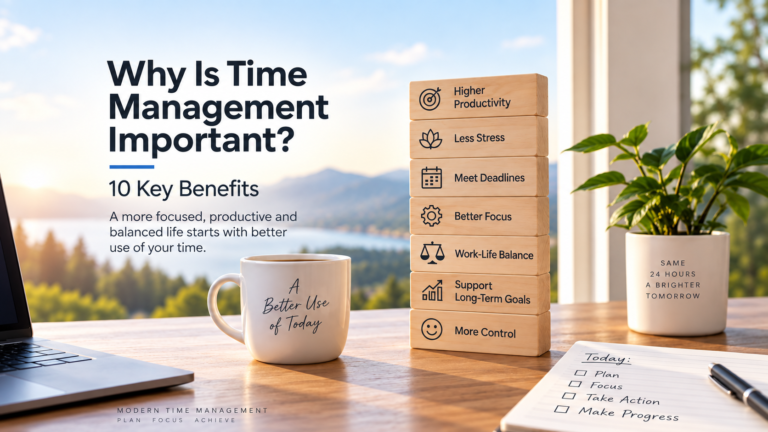
Better time management can support:
- more consistent progress on important goals;
- fewer missed deadlines;
- less last-minute rushing;
- better concentration and work quality;
- more realistic commitments;
- clearer boundaries between work and personal time;
- greater control over a busy schedule.
These outcomes explain why time management is important for both productivity and well-being.
10 Essential Time Management Skills
1. Prioritization
Prioritization is the ability to identify which tasks should receive attention first. It prevents easy, visible, or noisy activities from consuming time that should be used for higher-value work.
To prioritize well, consider impact, urgency, deadlines, dependencies, and the cost of delay. A useful question is: If only one of these tasks were completed today, which result would matter most?
Prioritization also means deciding what not to do. Some tasks can be postponed, simplified, delegated, or removed completely.
2. Planning
Planning is one of the core time management skills because it turns intentions into a workable schedule. It involves choosing when tasks will happen, how they fit together, and what resources they require.
Good planning can happen at several levels. A weekly plan provides direction, a daily plan selects immediate priorities, and project planning breaks a large result into smaller stages.
A useful plan should guide action without becoming rigid. Leave open space for interruptions, delays, and tasks that take longer than expected.
3. Task Organization
Furthermore, organization supports time management skills by keeping commitments in a reliable place instead of depending on memory. This may involve a task list, calendar, project board, notebook, or a simple combination of tools.
The system should make it easy to see what needs attention now, what is waiting, and what has a deadline. Too many lists and categories can create additional work, so simplicity is usually an advantage.
4. Time Estimation
Time estimation is another of the essential time management skills. It is the ability to predict how long a task will realistically take. It is essential because even a well-prioritized plan fails when every activity is underestimated.
Include preparation, communication, review, and switching time in your estimate. Compare estimates with actual durations and use the difference to improve future plans.
When a task is unfamiliar, create a range rather than a single optimistic number. For example, plan for 60–90 minutes instead of assuming exactly one hour.
5. Focus and Attention Management
However, time management skills are not only about schedules. Time is only useful when attention is available. Focus means directing your attention to one meaningful task long enough to make progress.
Practical focus habits include silencing unnecessary notifications, closing unrelated tabs, working in defined sessions, and keeping a short note for distracting ideas that can be handled later.
Single-tasking is often more effective than repeatedly switching between demanding activities. Each switch creates a small recovery cost and makes deep concentration harder.
6. Decision-Making
Consequently, decision-making is central to effective time management skills. Every schedule contains decisions. Should you accept another task? Attend a meeting? Answer a message now? Improve a finished document further?
Strong decision-making skills help you compare the benefit of an activity with the time it will consume. They also reduce the delay caused by repeatedly reconsidering the same choice.
Define simple rules for frequent decisions. For example, a meeting may require a clear purpose and agenda before you accept it.
7. Goal Setting
In addition, goal setting strengthens time management skills by providing direction for daily priorities. Without a clear result, it is difficult to decide whether a task is useful or merely urgent.
Effective goals are specific enough to guide action. “Improve the website” is vague. “Rewrite the homepage introduction and test the contact form by Friday” gives you a clearer next step.
Break long-term goals into milestones and identify the next visible action. This makes progress easier to schedule and measure.
8. Delegation
For managers, time management skills also include delegation: the ability to assign appropriate work to another person while providing enough context, authority, and support for success.
It is not simply transferring unwanted tasks. Good delegation matches the task with the right person, explains the expected result, sets a deadline, and agrees on how progress will be checked.
When you keep every task yourself, your personal capacity becomes the limit for the entire project.
9. Communication and Boundary Setting
Meanwhile, communication is one of the time management skills that becomes more important when schedules are affected by other people. Clear communication prevents vague requests, hidden deadlines, and unnecessary interruptions from controlling your day.
Boundary setting may include declining low-value meetings, explaining when work can realistically be completed, protecting focus time, or asking someone to clarify which of two urgent tasks should come first.
A realistic “not today” is often more useful than an unreliable “yes.”
10. Review and Adaptability
Finally, adaptable time management skills matter because no plan survives every change. Review and adaptability allow you to notice what happened, update priorities, and create a better plan for the next day or week.
A short review can answer four questions:
- What was completed?
- What remains unfinished?
- What took longer than expected?
- What needs to change next time?
This prevents the same planning mistakes from repeating indefinitely.
Planning and Prioritization Skills in Practice
Planning and prioritization work together. Strong planning skills reserve realistic time, while task prioritization determines which result deserves that time first. Therefore, these time management skills should be practiced as one connected habit rather than as separate techniques.
Examples of Time Management Skills at Work
Time management skills become easier to understand when they are connected to everyday situations.
- Before starting the day: choosing three important outcomes instead of working through email in arrival order.
- During a project: dividing a large deadline into research, drafting, review, and delivery stages.
- When interruptions appear: recording non-urgent requests and returning to the current focus block.
- When capacity is full: negotiating a deadline or asking which existing priority should be delayed.
- At the end of the week: reviewing unfinished tasks and using actual durations to improve next week’s estimates.
How to Identify Your Strongest and Weakest Skills
Look for recurring patterns rather than judging yourself after one difficult day. If deadlines are frequently missed, the problem may involve planning or estimation. If important work is continually postponed, prioritization or task clarity may be the issue. If plans are reasonable but progress is slow, interruptions and attention may deserve closer examination.
Track one normal week. Note planned tasks, actual time used, interruptions, unfinished work, and moments when priorities changed. The goal is not perfect data. It is to find the repeated point where your system breaks down.
How to Improve Time Management Skills
- Choose one skill first. Improving everything simultaneously creates another unrealistic project.
- Use a small measurable habit. For example, identify tomorrow’s top three priorities before ending the workday.
- Test the habit for one or two weeks. Give it enough time to reveal whether it helps.
- Review the result. Notice what changed and what continued to cause difficulty.
- Adjust gradually. Keep useful habits and simplify anything that creates more administration than value.
Time management skills improve through observation and repetition, not through finding a perfect productivity application.
Common Mistakes to Avoid
- planning every minute and leaving no buffer;
- confusing a long task list with clear priorities;
- underestimating routine work;
- checking messages continuously;
- accepting commitments before checking capacity;
- changing tools instead of changing habits;
- skipping the weekly review.
Frequently Asked Questions
What are the five main time management skills?
Five foundational skills are prioritization, planning, time estimation, focus, and review. Other abilities such as organization, delegation, communication, and boundary setting support them.
Can time management skills be learned?
Yes. They are practical behaviors that improve through repeated use, honest review, and gradual adjustment. Start with the recurring problem that causes the greatest disruption.
Is time management the same as productivity?
No. Time management concerns how you allocate time. Productivity concerns the useful results produced. A full schedule can still be unproductive if it focuses on low-value work.
What is the most important time management skill?
Prioritization is often the best starting point because efficient work has limited value when it is directed toward the wrong tasks. However, the most useful skill for you depends on where your current system fails.
Final Thoughts
In summary, time management skills help you make clearer decisions about limited time. Planning and prioritization provide direction, task prioritization protects high-value work, and planning skills turn those choices into a realistic schedule. The most important abilities include prioritization, planning, organization, estimation, focus, decision-making, goal setting, delegation, communication, and review.
You do not need to master all of them at once. Identify one recurring problem, choose the skill most closely connected to it, and practice one small change until it becomes reliable. Better time management is usually built through consistent adjustments rather than a complete overnight transformation.





One Comment