Chapter 23: Defending Your Time and Availability
A plan protects no time by itself.
You can decide that 09:00–10:30 is your most important work block. You can put it in the calendar. You can identify exactly what you intend to accomplish.
But if you spend that period answering messages, accepting unscheduled calls, solving other people’s problems, checking notifications, or doing easier tasks instead, the plan has changed nothing.
The original version of this course defined defending your time in a very practical way:
Use the time for the activity you deliberately planned it for.
This remains one of the most important ideas in time management.
Defending your time does not mean refusing to help people, ignoring customers, becoming unavailable, or following your schedule regardless of changing circumstances.
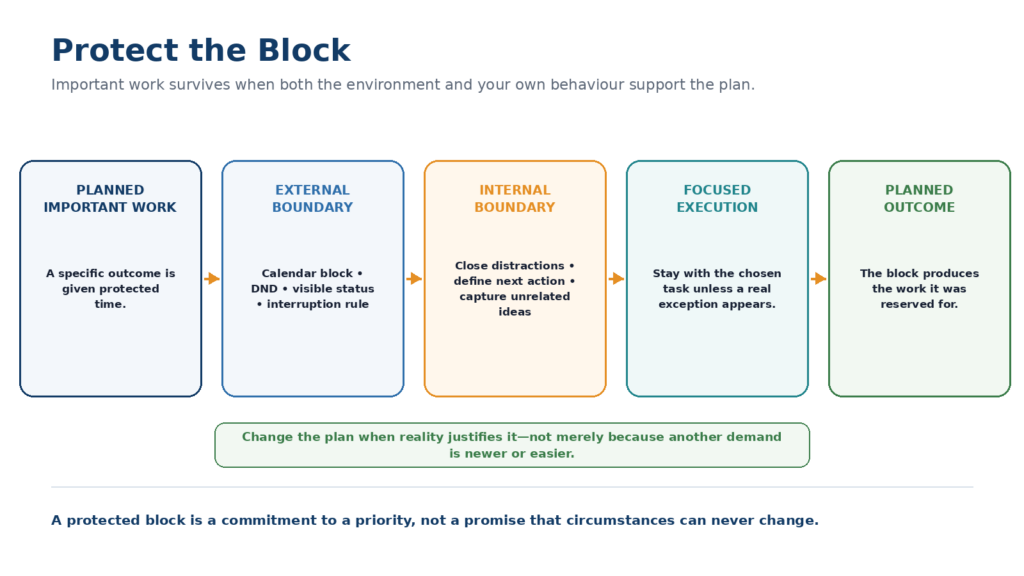
It means that changes to your plan should happen for a reason—not merely because something else was easier, newer, louder, or more convenient for somebody else.
Your calendar becomes useful only when a planned block has some protection against competing claims on your attention.
Protect Time from Others—and from Yourself
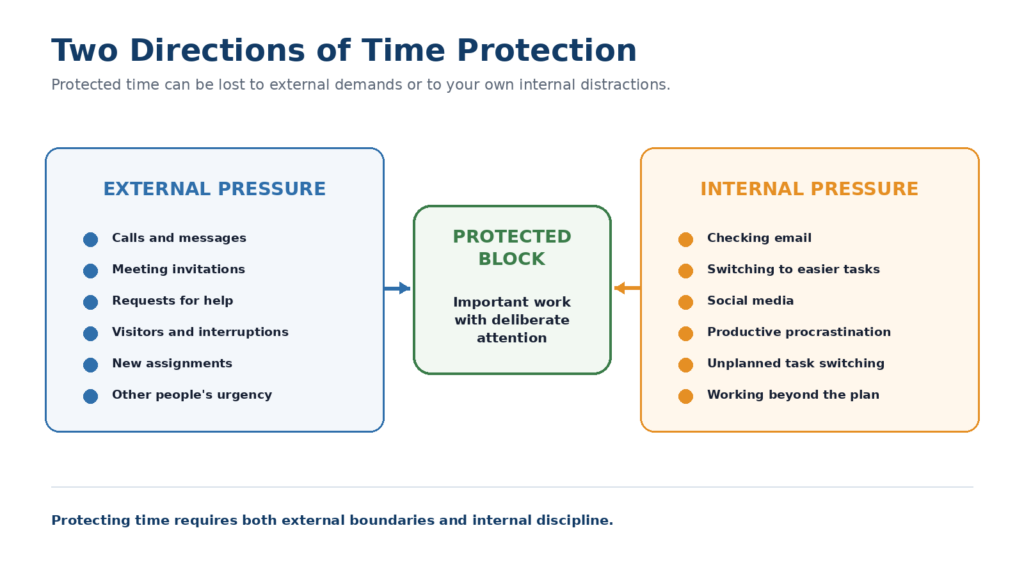
There are two broad ways planned time disappears.
External pressure comes from other people and systems:
- calls;
- messages;
- meeting invitations;
- requests for help;
- new assignments;
- visitors;
- other people’s urgent problems.
Internal pressure comes from you:
- checking email during a focus block;
- switching to easier tasks;
- opening social media;
- accepting every invitation because saying no feels uncomfortable;
- continuing to work after the planned working day has ended;
- allowing minor tasks to replace important ones.
You therefore need both boundaries and self-management.
A closed door does not protect your time if you spend the next hour checking messages yourself.
Availability Is Not the Same as Responsibility
Modern communication tools make it technically possible to be reachable almost continuously.
That does not mean continuous availability is required or useful.
There is an important difference between:
- being responsible for something; and
- being instantly available whenever something related to it appears.
You may be responsible for answering customers without answering every message within thirty seconds.
You may manage a team without responding immediately to every Teams message.
You may be helpful without leaving your entire calendar open for unscheduled requests.
The practical question is:
“How quickly does this genuinely need access to me?”
Create Levels of Availability
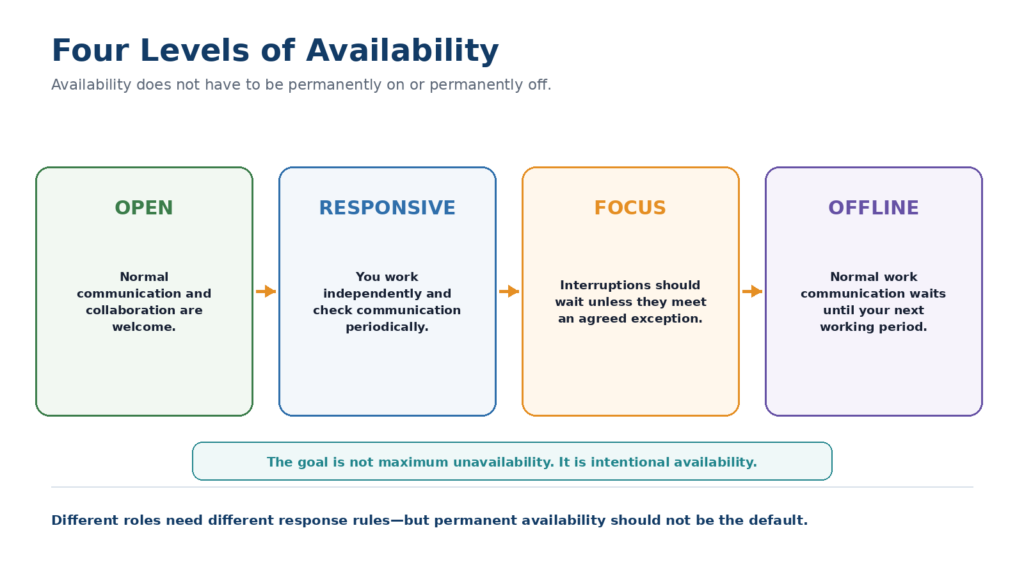
Instead of thinking only in terms of available or unavailable, create several levels.
- Open: normal communication and collaboration are welcome.
- Responsive: you are working independently but checking communication periodically.
- Focus: interruptions should wait unless they meet an agreed exception.
- Offline: you are outside working time and normal work communication waits until later.
Different jobs need different levels. A nurse, customer-support agent, manager, researcher, salesperson, and software developer cannot use identical availability rules.
The point is not to copy somebody else’s schedule.
The point is to stop treating your availability as one permanent setting.
Example 23.1 — Always Green on Teams
Daniel works as a project manager. He wants colleagues to see him as responsive, so Teams remains open throughout the day and he answers most messages immediately.
His team appreciates the fast replies.
But Daniel increasingly completes his own project planning after 17:00 because daytime hours are fragmented by small questions.
He changes his availability pattern:
- 09:00–10:30 — Focus; notifications muted.
- 10:30–12:00 — Normal availability.
- 13:00–14:00 — Meetings and team questions.
- 14:00–15:30 — Responsive; messages checked periodically.
- 15:30–16:00 — Open support period.
The team still has substantial access to him. They simply no longer have identical access every minute of the day.
Daniel did not become less responsible. He made his availability more deliberate.
Put Important Work in the Calendar—and Treat It as Real
Many people protect meetings better than they protect their own work.
If the calendar contains “Customer meeting 10:00–11:00,” they rarely schedule another meeting on top of it.
But if they intended to spend 10:00–11:00 preparing a proposal without putting that time in the calendar, it appears available to everybody—including themselves.
Use calendar blocks for work that genuinely needs protected time.
Examples:
- Proposal draft — 09:00–10:30
- Quarterly analysis — 13:00–14:00
- Study — 19:00–20:00
- Weekly planning — Friday 15:00–15:30
Do not block every minute. Calendar protection should identify genuinely valuable periods, not produce a fictional schedule that collapses at the first unexpected event.
Make Your Boundaries Visible
A boundary works better when people know it exists.
You might communicate:
- “I normally do focused work until 10:30. I’ll reply after that.”
- “I don’t monitor Teams continuously, but I check it several times during the day.”
- “If something genuinely cannot wait, call me.”
- “My working day normally ends at 17:00. Messages after that are handled the next working day.”
Tools can reinforce these expectations through calendar status, Do Not Disturb, Focus modes, working-hour settings, status messages, and notification schedules.
But technology cannot replace the social agreement.
If your status says “Focus” but you answer every message immediately, people learn that the status has little meaning.
Boundaries become credible through consistency.
Define the Exception
A boundary without an exception rule can create unnecessary anxiety.
If you tell colleagues not to interrupt you for two hours, they may reasonably ask:
“What if something genuinely urgent happens?”
Define the escalation route.
For example:
“Messages can wait until 10:30. If a customer operation has stopped completely, call me.”
This preserves focus without pretending emergencies do not exist.
Do Not Confuse Other People’s Urgency with Your Priority
Someone else’s request can be urgent to them without becoming your highest priority.
When a new demand appears during protected time, ask:
- What happens if this waits?
- Who decided the deadline?
- Does another person have the authority or information to handle it?
- What planned work will be displaced?
- Is the trade-off worth making?
If the answer is yes, change the plan deliberately.
Time protection should never become rigid adherence to an outdated plan.
The objective is not “never change the schedule.” It is “know why you changed it.”
Example 23.2 — The Calendar Block That Always Lost
Sophia blocks Tuesday afternoon for developing a new training programme.
For four consecutive weeks, the block disappears:
- week one — a colleague asks for help;
- week two — she accepts a meeting;
- week three — she catches up on email;
- week four — she decides to clear several small administrative tasks first.
Nothing dramatic happened.
That is precisely the problem.
The strategic work continually loses to activities that are easier to justify in the moment.
Sophia starts treating the block like a real appointment. Meetings can replace it only when she consciously decides that the meeting is more important. Routine administration cannot.
Within the next month, the programme finally begins moving forward.
Important-but-not-urgent work often needs protection precisely because nothing forces you to protect it.
Defend Your Time from Yourself
The original course emphasized that other people are only half of the problem.
You can silence every notification and still abandon the planned task yourself.
During a protected block:
- close unrelated applications;
- keep the phone away when appropriate;
- define the exact next action before beginning;
- capture unrelated ideas instead of acting on them;
- avoid replacing difficult work with productive-looking administration;
- use a planned break rather than an undefined digital escape.
Chapter 20 explored these time wasters in greater detail.
Here the principle is:
If you protected an hour from everybody else, do not give that hour away to your own impulses.
Protect Personal Time from Work
Time protection must work in both directions.
During work, protect important work from unnecessary personal interruptions.
Outside work, protect important personal time from unnecessary work expansion.
Without a stopping rule, work can expand indefinitely because there is almost always something else you could do.
You can answer one more email. Improve one more slide. Review one more document. Prepare slightly more for tomorrow.
For some periods, extra work is necessary.
But if the normal solution to insufficient capacity is permanently extending the working day, the system needs attention.
Create an approximate boundary:
- normal finishing time;
- conditions that genuinely justify working later;
- periods when work communication is not checked;
- personal commitments that receive the same calendar respect as work commitments.
Remote Work Makes Boundaries More Important
The original course warned that working and living in the same place can become “living at the office.”
That risk is even more visible in remote and hybrid work.
When the laptop is always nearby, beginning or continuing work has almost no physical barrier.
Useful boundaries include:
- a defined workspace where possible;
- an approximate start and finish time;
- a shutdown routine;
- closing work applications after work;
- separating work and personal notification profiles;
- physically putting the laptop away when the working day is finished.
A shutdown routine can be very simple:
- Capture unfinished tasks.
- Check tomorrow’s first important commitment.
- Close work applications.
- End communication monitoring unless you are genuinely on call.
This tells both your systems and your mind that today’s work has ended.
Protect Valuable Personal Time Too
The original course also made a broader point: free time should not consist only of whatever remains after everybody else has made claims on it.
Your personal priorities may include:
- family;
- friends;
- exercise;
- hobbies;
- learning;
- travel;
- reading;
- rest;
- simply having unscheduled time.
You do not need to convert leisure into another productivity project.
But if something matters to you and repeatedly receives no time, relying on “when I have time” may not work.
A family dinner, exercise session, evening class, weekend trip, or quiet evening can deserve the same deliberate protection as a professional appointment.
Protecting personal time is not the opposite of time management. It is one of its purposes.
Think in Opportunity Cost, Not Only Money
The original course suggested calculating the monetary value of an hour to make time feel more concrete.
This can be useful, particularly when deciding whether to outsource or eliminate low-value work.
But your time is not valuable only because it can earn money.
An unnecessary Saturday work session might cost no salary at all.
Its opportunity cost could instead be:
- time with your family;
- recovery;
- exercise;
- study;
- a hobby;
- sleep;
- an important personal project.
Whenever somebody—or you yourself—asks for an hour, ask:
“What will this hour replace?”
This is often more useful than asking only whether the activity itself has value.
Example 23.3 — Working from Home Became Always Working
Martin works remotely three days each week.
His formal workday ends at 17:00, but the laptop remains open on the dining table.
At 18:15 he notices an email and answers it. At 19:00 he remembers a document that could be improved. At 21:20 he checks Teams before bed.
No individual action seems unreasonable.
But psychologically, Martin never really leaves work.
He introduces a 10-minute shutdown routine at 17:00. Unfinished tasks go into his system, tomorrow’s first task is selected, applications are closed, and the laptop goes into a cabinet.
Urgent operational issues still have a separate phone route.
Martin has not made himself unreachable.
He has stopped using permanent availability as the default.
Review Boundaries When Your Role Changes
Your availability system should not become rigid.
A new job, new manager, young child, major project, customer crisis, study programme, or different time zone may require different boundaries.
Ask periodically:
- When do people genuinely need immediate access to me?
- When am I unnecessarily available?
- Which important work repeatedly loses its protected time?
- Which personal role is repeatedly losing time to work?
- Which boundaries create unnecessary friction for other people?
- What should change?
Good boundaries serve your responsibilities. They are not a reason to ignore them.
Exercise 23.1 — The Protected-Time Audit
Look at five blocks of important work that you planned during the last two weeks.
For each one, ask:
- Did the work actually happen?
- If not, what replaced it?
- Was the change deliberate?
- Did another person take the time?
- Did I give the time away myself?
- What boundary or system could have protected it better?
Look for repeated causes rather than treating every failed block as a separate event.
Exercise 23.2 — Design Your Availability Rules
Define your normal rules for four states:
- Open: When are you freely available?
- Responsive: How often will you normally check communication?
- Focus: What periods should be protected?
- Offline: When does normal work communication stop?
Then define one exception:
What genuinely justifies interrupting your focus or offline period, and which channel should be used?
Exercise 23.3 — Protect One Personal Priority
Identify one personal activity that matters but repeatedly receives less time than you want.
Schedule one concrete block for it during the next seven days.
Then give it the same test you would give an important work commitment:
- What would justify moving it?
- What would not justify moving it?
- What needs to happen beforehand so that work does not automatically expand into this period?
The objective is not to make leisure rigid. It is to discover whether you treat personal priorities as real priorities.
Your Availability Should Be a Choice, Not a Default
You cannot control every demand on your time.
Plans change. Emergencies occur. Other people need you. Some jobs require rapid response. Some periods genuinely require longer hours.
Defending your time does not mean resisting reality.
It means protecting your ability to make choices inside that reality.
Decide when you are open. Decide when you need focus. Communicate response expectations. Create escalation routes for genuine urgency. Protect important work from trivial demands. Protect personal time from unlimited work expansion.
And when you change the plan, know what you are trading away.
Your time does not need to be inaccessible. It needs to stop being automatically available to every competing demand.
Key Takeaways
- Defending your time means using planned time for its intended purpose unless there is a good reason to change the plan.
- Time needs protection from both external demands and your own distractions.
- Responsibility does not automatically require constant availability.
- Think in levels of availability: Open → Responsive → Focus → Offline.
- Put genuinely important work into the calendar and treat those blocks as real commitments.
- Make boundaries visible through communication, calendars, status settings, Focus modes, and consistent behaviour.
- Define what qualifies as an exception to protected time.
- Do not automatically convert someone else’s urgency into your highest priority.
- Plans should change deliberately when circumstances justify it.
- If you protect time from other people, protect it from your own impulses as well.
- Time protection must work in both directions: protect work from unnecessary interruptions and personal life from unnecessary work expansion.
- Remote work needs explicit starting, finishing, communication, and shutdown boundaries.
- Personal priorities sometimes need calendar protection too.
- Think about the opportunity cost of time, not only its monetary value.
- Review availability rules when your responsibilities or life circumstances change.
- The goal is not maximum unavailability. It is intentional availability.