This is one full chapter from the Modern Time Management e-course. The course includes 40 practical chapters across six modules.
Your time is rarely lost because of one major mistake. It is usually consumed by dozens of small decisions, interruptions, messages, meetings, and tasks that pull attention away from more important work. Effective time management is not simply about doing more — it is about making more deliberate choices about where to invest your time, attention, and energy.
Chapter 1: Why Manage Time?
We all have the same basic constraint: a day contains only 24 hours.
Yet people with similar jobs, responsibilities, and resources can experience time very differently. One person may feel constantly rushed and behind. Another may handle a comparable workload while still finding time for relationships, exercise, learning, and rest.
The difference is rarely that one person has somehow discovered more hours.
It is more often about what receives attention, what gets ignored, what gets protected, and what is allowed to consume time without a deliberate decision.
Modern time management is therefore not primarily about squeezing more tasks into your day. It is about making better choices about where your limited time, attention, and energy go.
The Feeling of Never Having Enough Time
“I don’t have enough time” is one of the most common explanations for unfinished work, postponed goals, neglected relationships, missed exercise, and lack of rest.
Sometimes the problem really is lack of capacity. A person may simply have more responsibilities than can reasonably fit into the available hours.
But often the situation is more complicated.
You may have enough time for something in theory, but that time is fragmented by messages, meetings, interruptions, small administrative tasks, household responsibilities, or digital distractions.
You may spend hours reacting to what other people consider urgent while making almost no progress on work that matters to you.
Or you may reach the end of the day having been busy almost continuously and still struggle to identify what meaningful result all that activity produced.
This leads to an important principle:
Lack of time and poor use of time are not the same problem.
Good time management starts by understanding which problem you actually have.
Can You Really Manage Time?
Strictly speaking, you cannot manage time.
Time continues to pass at exactly the same rate regardless of how productive, organized, distracted, motivated, or exhausted you are.
You cannot slow it down, store unused hours for another day, or recover yesterday’s wasted time.
What you can manage are your decisions and behaviours within time.
You can decide:
- what deserves your attention;
- what you will not do;
- when important work will happen;
- which tasks should be delayed, delegated, automated, or eliminated;
- when you will be available to other people;
- when you need uninterrupted focus;
- when you need recovery rather than more work.
For this reason, “time management” is really a convenient name for something broader: managing priorities, commitments, attention, energy, and action within limited time.
Time Is a Non-Renewable Resource
Many resources can be replaced.
Money can be earned again. A lost file may be restored from a backup. Equipment can be repaired or replaced. Skills can be relearned.
Time is different.
An hour that has passed cannot be used again.
This does not mean that every minute should be productive. Rest, entertainment, conversation, play, thinking, and doing nothing can all be valuable uses of time.
The important distinction is not between productive time and wasted time.
A more useful distinction is between intentional and unintentional time use.
Watching a film because you deliberately want to relax may be an excellent use of two hours.
Spending the same two hours automatically scrolling through content you did not intend to consume may feel very different afterwards.
The question is therefore not:
“Was every minute productive?”
A better question is:
“Did my time go where I wanted it to go?”
Busyness Is Not the Same as Progress
Being busy can feel productive.
A full calendar, a long task list, dozens of messages, and constant movement create visible evidence that you are doing something.
But activity is not the same as progress.
You can answer twenty emails and avoid the one difficult task that would move an important project forward.
You can attend six meetings without making a meaningful decision.
You can reorganize your task-management system instead of completing the task that has been sitting in it for three weeks.
You can work for ten hours and spend very little of that time on the things that matter most.
This is why one of the central questions of modern time management is not:
“How much did I do?”
but:
“What did my effort actually move forward?”
Efficiency means doing something with less waste.
Effectiveness means doing something that actually deserves to be done.
The order matters:
First choose the right things. Then become efficient at doing them.
Example 1.1 — A Busy Day That Achieved Almost Nothing
Daniel starts work at 8:30.
Before beginning his most important project, he checks email “for a few minutes.” Several messages require quick replies, one leads him to open a spreadsheet, and another reminds him of a small administrative task.
At 9:20, a colleague sends him a message asking a quick question. Daniel answers immediately. The conversation continues for fifteen minutes.
At 10:00, he attends a meeting. The meeting lasts an hour, but no important decision is made.
After the meeting, Daniel checks email again. He answers several messages, updates his task list, downloads a document, and reorganizes some files.
By lunchtime, he has been active almost continuously.
In the afternoon, more messages arrive. He attends another meeting, helps a colleague with a problem, makes two phone calls, and completes several small tasks.
At 17:30, Daniel feels tired. He has answered 34 emails, attended two meetings, completed nine small tasks, and responded quickly whenever someone needed him.
He has been busy for almost the entire day.
But the important proposal he planned to finish that day is still almost untouched.
Daniel did not have an inactive day.
He had a high-activity, low-progress day.
The problem was not that he did nothing. The problem was that his time and attention were repeatedly captured by tasks that were easier, more immediate, or more visible than the work that mattered most.
The lesson is simple:
A full day is not necessarily a productive day.
A useful end-of-day question is not only:
“What did I do today?”
but also:
“What important result did I move forward today?”
Time Is Not Your Only Limited Resource
Traditional time management often treats hours as the main resource we need to organize.
But having time available does not automatically mean that you can use it well.
You may have two free hours but be too mentally exhausted to do demanding work. You may have an entire afternoon available but lose much of it to interruptions and fragmented attention. Or you may have enough time for an important task but keep postponing it because another activity feels easier or more urgent.
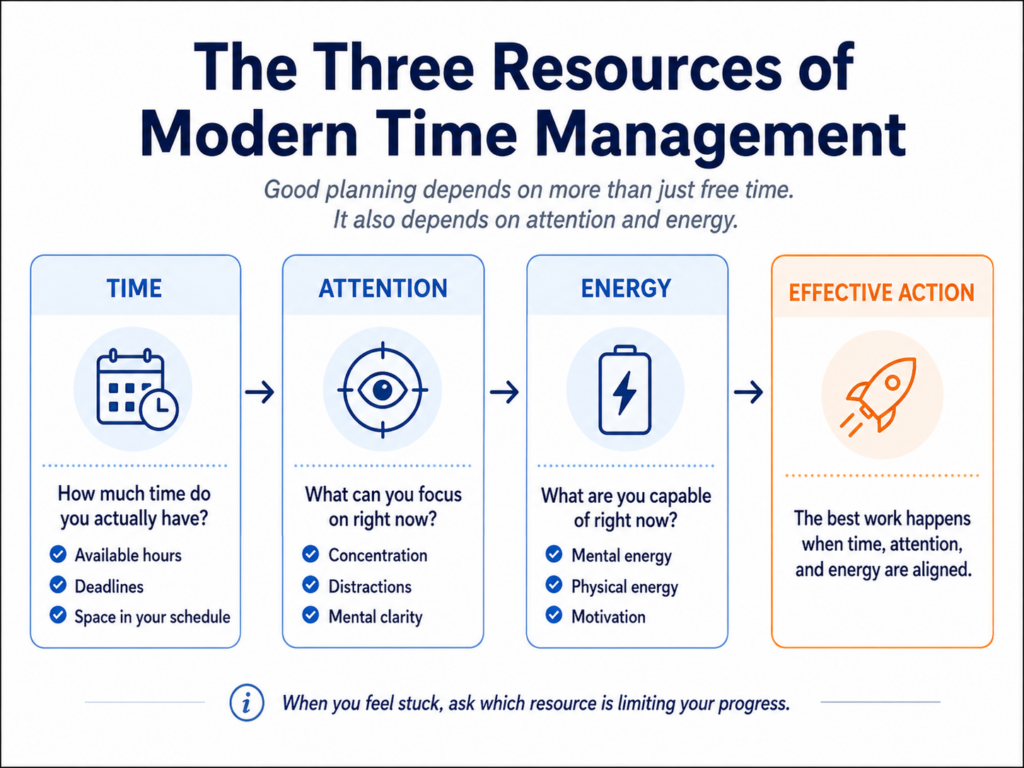
This is why modern time management needs to consider three limited resources:
Time. Attention. Energy.
Time
Time determines when and for how long you can do something.
It is fixed. Everyone receives the same 24 hours in a day, and unused time cannot be stored for later.
Planning helps you decide where those hours will go.
Attention
Attention determines what your mind is actually focused on during those hours.
An hour of uninterrupted concentration can produce very different results from an hour broken into short fragments by messages, notifications, browser tabs, and conversations.
You can be physically present at your desk while your attention is repeatedly somewhere else.
Protecting attention is therefore just as important as protecting time.
Energy
Energy determines what you are capable of doing well at a particular moment.
Some activities require deep concentration, creativity, patience, or difficult decision-making. Others can be completed when your energy is lower.
Trying to perform demanding work when you are mentally exhausted often leads to slower progress, more mistakes, and more procrastination.
Effective planning therefore means not only finding a free hour, but also asking whether that hour is suitable for the work you intend to do.
Good Time Management Coordinates All Three
Consider two situations.
In the first, you have enough time, but your phone interrupts you every few minutes. Attention becomes the limiting resource.
In the second, you have an uninterrupted evening available, but you are exhausted after a demanding day. Energy becomes the limiting resource.
In the third, you are rested and able to focus, but your calendar is completely full. Time becomes the limiting resource.
The problem can therefore be different even when the result feels the same:
“I am not getting enough done.”
Before trying another productivity technique, ask:
- Do I actually lack time?
- Is my attention being fragmented?
- Is my energy too low for the work I am trying to do?
The solution depends on the answer.
You cannot solve an attention problem simply by working longer.
You cannot solve an energy problem simply by creating a longer task list.
And you cannot solve a genuine capacity problem by becoming slightly more efficient.
Modern time management starts by identifying which resource is actually limiting your progress.
What Do You Want Your Time to Produce?
Time management makes little sense without direction.
You can become extremely efficient at answering messages, organizing files, attending meetings, completing small tasks, and maintaining a perfectly structured calendar.
But efficiency alone cannot tell you whether those activities deserve your time.
Before improving how you work, it is worth asking a more fundamental question:
What do you want your time to produce?
The answer will be different for different people.
You may want your time to contribute to:
- meaningful work;
- financial security;
- professional growth;
- relationships;
- raising a family;
- health and fitness;
- learning;
- creativity;
- travel and experiences;
- contribution to other people;
- rest and enjoyment.
None of these automatically deserves priority over the others.
The point is that your calendar should, over time, reflect what actually matters to you.
If something is important in theory but receives almost no time, attention, or energy for months or years, there is a gap between your stated priorities and your actual behaviour.
Time management helps make that gap visible.
Your Calendar Reveals Your Real Priorities
People often describe their priorities in words.
They may say that health is important, that family comes first, that they want to build a business, complete a degree, learn a language, or spend more time with friends.
But priorities are also revealed through behaviour.
Your calendar, task list, screen time, spending patterns, and repeated habits provide evidence about where your resources are actually going.
This does not mean that every important part of life should receive equal time.
Nor does it mean that every week must perfectly reflect your values.
There will always be demanding periods, deadlines, unexpected events, and temporary imbalances.
The useful question is whether a temporary situation has quietly become the default.
If you have been saying “I will make time for this when things calm down” for the past two years, the problem may no longer be temporary.
Intentional Time vs Reactive Time
A useful distinction is between intentional time and reactive time.
Intentional time is time you deliberately allocate to something because you have decided that it deserves your attention.
Examples include:
- working on an important project;
- exercising;
- studying;
- spending time with your family;
- resting;
- meeting a friend;
- reading for pleasure.
Reactive time begins when something external captures your attention and determines what you do next.
Examples include:
- responding immediately to every new message;
- opening email every few minutes;
- joining an unnecessary meeting because someone invited you;
- allowing notifications to repeatedly interrupt focused work;
- dealing with other people’s priorities before considering your own;
- automatically opening social media whenever you have a spare moment.
Reactive activity is not automatically bad.
Some jobs require rapid responses. Emergencies happen. Other people genuinely need help.
The problem appears when reaction becomes your default operating mode.
If most of your day is determined by whatever arrives next, you may remain extremely busy while giving very little time to work that requires deliberate investment.
Good time management therefore creates space for both:
planned action and necessary reaction.
The goal is not to eliminate interruptions or spontaneity.
The goal is to prevent them from controlling your entire day.
You Cannot Do Everything
One of the most important ideas in time management is also one of the least comfortable:
There will always be more things you could do than time available to do them.
New tasks appear continuously.
There are always more books to read, messages to answer, projects to begin, skills to learn, places to visit, improvements to make, and opportunities to pursue.
Technology has made this even more visible. Your possible inputs are almost unlimited, while your available time remains limited.
This means that good time management cannot be based on the goal of eventually completing everything.
You will never reach the end of all possible work.
Instead, effective time management requires selection.
Every meaningful yes consumes resources that could have been used elsewhere.
Choosing one project may mean postponing another.
Accepting one meeting removes time from something else.
Working late may reduce recovery or family time.
Even leisure involves choice: an hour spent on one form of entertainment is an hour unavailable for another.
This is not a failure of time management.
It is the basic reality that makes time management necessary.
The goal is not to do everything.
The goal is to make better choices about what deserves to be done.
Exercise 1.1 — Where Is Your Time Actually Going?
Choose five areas of life that you say are important to you.
Examples might include work, family, health, learning, relationships, a personal project, financial security, or recovery.
For each one, ask yourself:
- How important is this area to me on a scale from 1 to 10?
- How much deliberate time and attention did I give it during the last seven days?
- Am I satisfied with that difference?
Then identify:
- One important area receiving less attention than it deserves
- One area receiving more time or attention than it deserves
- One activity that repeatedly consumes time without a deliberate decision
Now choose one small change for the next seven days.
Make it concrete.
Instead of:
“I should exercise more.”
choose:
“I will block Tuesday and Thursday from 18:00 to 18:45 for exercise.”
Instead of:
“I should spend less time on my phone.”
choose:
“I will keep social media apps closed until after lunch.”
The purpose of this exercise is not to judge how you used your time.
It is to notice whether your actual time use reflects your stated priorities.
Quick check: If someone could see only your calendar and your screen-time data, what would they assume your priorities are?
What Time Management Can — and Cannot — Do
Time management is useful, but it is not magic.
It cannot create additional hours in the day.
It cannot make an unrealistic workload realistic.
It cannot guarantee that other people will respect your plans.
It cannot prevent emergencies, illness, technical problems, changing priorities, or unexpected events.
And it cannot turn every hour into a period of perfect concentration and high performance.
This is important because productivity advice sometimes creates an unrealistic expectation: that if you just find the right system, app, routine, or technique, you will finally be able to fit everything into your life.
Usually, you cannot.
A good time-management system does something more useful.
It helps you:
- see where your time is going;
- decide what matters;
- distinguish important work from noise;
- protect time for priorities;
- reduce unnecessary commitments;
- organize tasks so that they are easier to act on;
- create realistic plans;
- manage interruptions;
- make better use of your attention and energy;
- recognize when the problem is not efficiency but too much work.
Sometimes the most productive decision is not to work faster.
It is to remove something from the system.
Productivity Is Not the Goal
It is easy to turn productivity itself into a goal.
You may begin tracking tasks, optimizing routines, testing apps, improving workflows, and trying to become increasingly efficient.
But productivity is only useful if it serves something beyond itself.
Completing more tasks is not automatically better.
Working faster is not automatically better.
Having an empty inbox is not automatically better.
A perfectly organized calendar is not automatically better.
The real question is whether your way of using time helps you create the results and life you actually want.
For one person, better time management may mean completing more high-value work during the working day.
For another, it may mean finishing work earlier.
For someone else, it may mean making consistent progress on a degree, business, creative project, or fitness goal.
And for another person, the most important result may be simply having enough space to recover and stop feeling permanently rushed.
There is no universal definition of a perfectly productive life.
There is only a better alignment between what matters to you and where your resources go.
A Better Definition of Time Management
For the purposes of this course, we will use a broader definition of time management:
Time management is the deliberate allocation of time, attention, and energy to activities that deserve them.
The word deliberate is important.
It does not mean that every minute must be scheduled.
It means that you increasingly make conscious choices instead of allowing habits, notifications, requests, urgency, and other people’s priorities to make all of those choices for you.
The purpose of planning is not to control every moment.
The purpose is to create enough structure that the things that matter do not repeatedly lose to the things that happen to appear first.
From Managing Time to Managing Your System
As you progress through this course, you will gradually build a personal system for managing your work and life.
You will learn how to:
- identify the roles and priorities that deserve your attention;
- turn goals into projects and concrete next actions;
- distinguish importance from urgency;
- understand where your time actually goes;
- plan realistically at different time horizons;
- protect periods of focused work;
- deal with incoming tasks and interruptions;
- communicate and collaborate with less wasted time;
- manage your energy and recovery;
- use digital tools without allowing them to control your attention;
- delegate and automate work where appropriate;
- use AI to reduce repetitive cognitive work;
- create boundaries between work and the rest of your life.
You do not need to adopt every technique in this course.
The goal is to understand the principles, test the tools that are relevant to you, and gradually build a system that fits your responsibilities, work, energy, and life.
The best time-management system is not the most complicated one.
It is the one that helps you repeatedly answer three questions:
What matters now?
What should I do next?
What should I stop doing?
Key Takeaways
- Key Takeaways
- Time management is not about creating more hours. It is about making better decisions within the time you already have.
- Being busy is not the same as making progress.
- Modern time management depends on three limited resources: time, attention, and energy.
- Lack of time, fragmented attention, and low energy are different problems and require different solutions.
- Your calendar and repeated habits reveal where your resources actually go.
- Good time management creates space for both intentional action and necessary reaction.
- You cannot do everything. Effective time management requires selection, trade-offs, and saying no.
- Productivity is not the final goal. It is useful only when it supports results and a life that matter to you.
- Sometimes the right solution is not to work faster, but to remove, reduce, delegate, or automate work.
- A useful time-management system should help you answer three questions: What matters now? What should I do next? What should I stop doing?
Want the full system?
This was one chapter from the Modern Time Management e-course.
The full course includes 40 practical chapters across six modules, covering priorities, planning, focus, communication, energy management, digital productivity, AI, automation, and building your personal productivity system.
You will also get practical exercises, examples, visual frameworks, and ready-to-use methods you can apply directly to your own work and daily routines.
Launch price: €59
Regular price: € 79