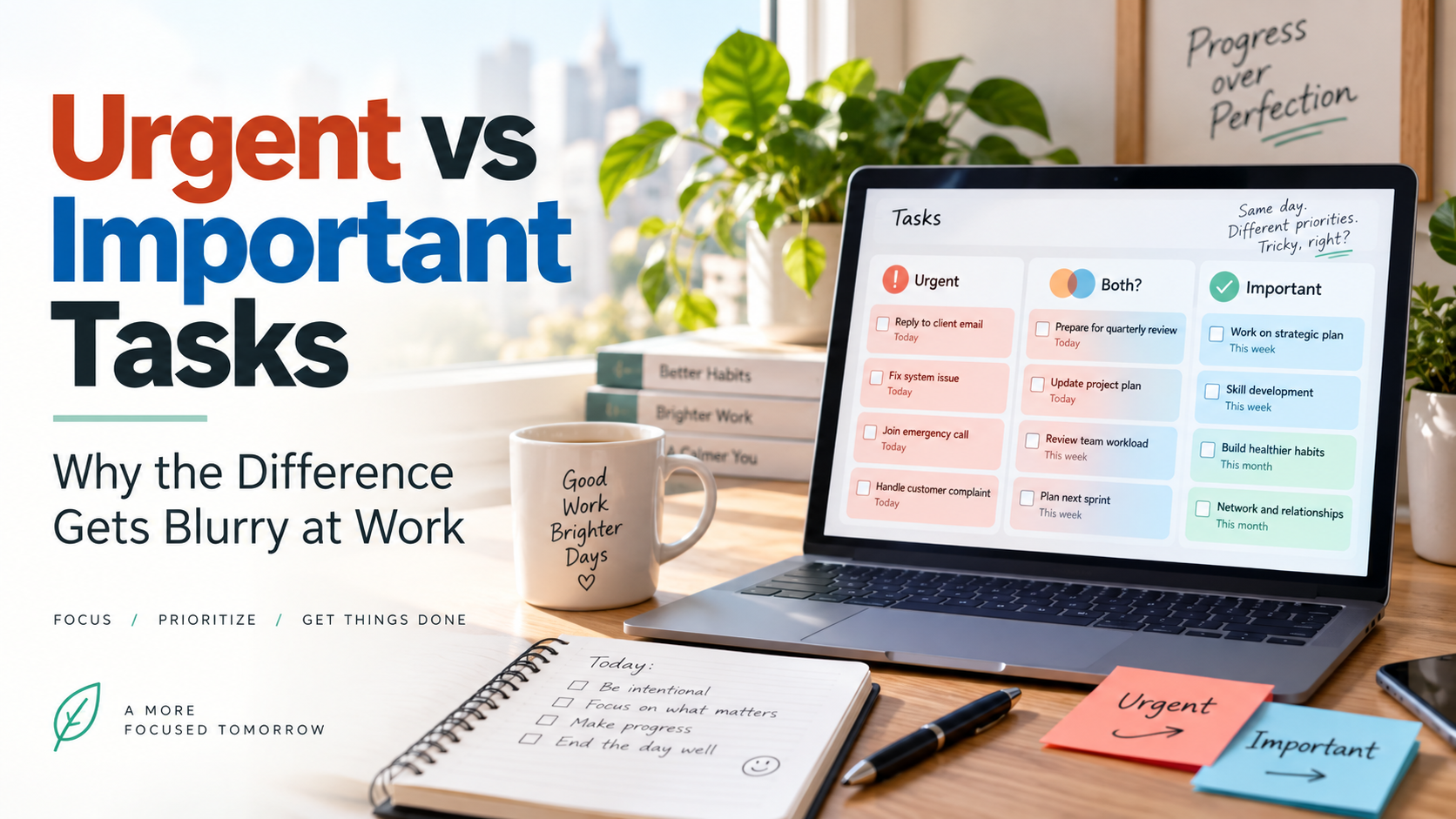
Urgent vs Important Tasks: Why the Difference Gets Blurry at Work
Search for urgent vs important tasks, and the distinction can look wonderfully clean.
One type of work needs attention quickly.
Another type matters because of its consequences or value.
Simple.
Then the working day begins.
A customer is waiting.
Your manager sends a message.
A deadline is approaching.
A colleague cannot continue without your answer.
A long-term project still matters.
A meeting suddenly moves forward.
An old task becomes overdue.
Now everything seems to have a reasonable argument for immediate attention.
The difference between urgent and important tasks may look obvious on paper.
In real working life, the two signals are often mixed together with hierarchy, visibility, fear, deadlines, social pressure and incomplete information.
That is where the interesting problem begins.
Why Do Urgent and Important Tasks Get Confused So Easily?
Because urgency is easy to notice.
It has signals.
A notification appears.
Someone calls.
A deadline turns red.
A customer follows up.
A manager asks again.
Importance can be much quieter.
A long-term project may matter enormously without producing any immediate signal.
Nothing flashes.
Nobody asks.
No alarm goes off.
The task simply continues to matter.
When one kind of work is loud and another is quiet, attention does not enter the competition under equal conditions.
Urgent Work Has Better Marketing
Imagine two tasks.
One sends you three reminders.
The other sends none.
One has a person waiting.
The other may prevent a future problem nobody can yet see.
One appears in red.
The other sits silently on a project list.
Which one feels more pressing at 10:17?
This is one reason the urgent vs important distinction becomes difficult in practice.
Urgency markets itself constantly.
Importance often assumes you will remember.
Notifications Create a Sense of Immediate Relevance
A new message arrives.
You do not yet know whether it matters.
But it is new.
That alone gives it an advantage.
The work already in front of you has been visible for an hour.
The message contains uncertainty.
What does it say?
Who sent it?
Is there a problem?
The notification may be trivial.
Your attention must often inspect it before learning that.
Urgency can begin before the content is even known.
The Red Badge Has More Power Than It Deserves
Unread email: 12
Teams messages: 4
Task manager: 3 overdue
Nothing about those numbers tells you what is actually important.
But visually they communicate unfinished business.
Something is waiting.
Perhaps several things.
This creates a low-level sense that the unseen items deserve inspection.
The long-term project on your screen may have far greater value.
It does not have a red circle.
Other People Make Urgency Much Harder to Ignore
A task on your private list can wait quietly.
A person waiting cannot.
“Any update?”
“Can you send this soon?”
“Do you have a minute?”
“Need this before the meeting.”
Now the task has a human face.
Ignoring it becomes socially more difficult.
That does not automatically make it more important.
It makes the consequences of delaying it more visible.
Someone Else’s Urgency Can Become Yours in Seconds
A colleague has a deadline.
They need your input.
Now their deadline appears inside your day.
Perhaps they knew about it for a week.
Perhaps they discovered it five minutes ago.
Either way, once they ask you, their time pressure becomes one of your competing demands.
Collaborative work allows urgency to travel extremely efficiently.
“ASAP” Is Surprisingly Powerful for Such a Vague Word
ASAP might mean:
five minutes,
before lunch,
today,
this week.
The word contains almost no precise scheduling information.
Yet it creates immediate pressure.
This is one of the stranger properties of workplace communication.
Very vague language can create a very specific emotional response.
The task suddenly feels urgent even though the actual deadline remains unclear.
Managers Can Accidentally Turn Ordinary Work Into Urgent Work
A manager writes:
Can you check this?
That may simply mean:
“When you have a chance.”
The employee may interpret it as:
“Stop everything.”
Hierarchy adds weight to otherwise ordinary language.
A request does not need the word urgent to behave like an urgent request.
Who asks can matter as much as what they ask.
Seniority Can Change the Perceived Importance of the Same Task
Imagine two people request something identical.
A colleague.
A senior executive.
Technically, the work is the same.
Psychologically, it may not feel the same.
The senior request carries visibility, evaluation and professional risk.
This complicates any neat distinction between importance and urgency.
Work does not exist outside organizational relationships.
Customer Requests Have Similar Gravity
A customer asks for something.
Even a relatively small question can become prominent.
Why?
The customer is external.
They may be dissatisfied.
Revenue may be involved.
Response time may be noticed.
The task now contains several additional meanings beyond the content itself.
A five-minute request can suddenly feel more important than a two-hour internal project.
Importance Can Depend on Who Is Looking
Some tasks have an audience.
Presentation to management.
Customer response.
Public deadline.
Others are nearly invisible.
Improve documentation.
Prevent a future error.
Think through a long-term issue.
The visible task often gains priority pressure because people will notice whether it happens.
The invisible task may be equally valuable.
Nobody is waiting to applaud it.
Important Preventive Work Has a Visibility Problem
Imagine spending two hours preventing a problem.
If you succeed, what happens?
Nothing.
No crisis.
No complaint.
No urgent call.
The achievement is the absence of an event.
Now compare that with solving a visible emergency.
Problem appears.
People panic.
You solve it.
Everyone sees the result.
Organizations can unintentionally celebrate emergency response more visibly than prevention.
That can shape which work feels important.
Firefighting Produces Better Stories
“We prevented a problem that never happened.”
Not very dramatic.
“We fixed a major issue in two hours.”
Much better story.
Urgent work often produces heroes because it contains visible tension and resolution.
Quiet important work can prevent the drama entirely.
The irony is that success may make its own value harder to observe.
A Calm Week Can Make Preventive Work Look Unnecessary
Nothing went wrong.
So perhaps that maintenance, preparation or checking was unnecessary.
But perhaps nothing went wrong because somebody did it.
Importance becomes difficult to judge when success removes the evidence that the task mattered.
This is a recurring problem in risk management, maintenance and planning work.
Important Work Often Has Weak Deadlines
A customer response:
today.
Monthly report:
Friday.
Improve internal process:
sometime this quarter.
Think about next year:
eventually.
Which tasks repeatedly win?
Deadlines provide an external forcing mechanism.
Important work without one must compete using value alone.
That is a much quieter argument.
“No Rush” Can Quietly Mean “Never”
Someone says:
“No rush.”
The task now has very little immediate pressure.
Another task arrives.
Then another.
The no-rush task moves.
Weeks later it remains.
Nothing about its intrinsic value necessarily changed.
It simply kept losing contests against work with clearer time signals.
A Task Can Become Urgent Without Becoming More Important
Monday:
ordinary task.
Tuesday:
postponed.
Wednesday:
postponed again.
Thursday:
deadline approaching.
Friday:
URGENT.
The task did not necessarily become more valuable.
Time disappeared.
This is one of the reasons urgency can be misleading when used as a proxy for importance.
Sometimes urgency is merely the history of previous delay made visible.
Overdue Labels Add Emotional Weight
Task due yesterday.
Now the system says:
OVERDUE
Same task.
Same outcome.
Different feeling.
The label adds discomfort.
The desire to remove that red warning can itself influence priority.
At some point, people may be completing tasks partly because they want the task manager to stop accusing them.
The Task List Can Manufacture Urgency
A due date may have been arbitrary.
You chose Friday because the software wanted a date.
Friday arrives.
Now the task is overdue.
Suddenly the arbitrary date has created real psychological urgency.
Digital productivity systems can turn tentative intentions into apparently objective deadlines.
The software rarely remembers which dates were genuinely fixed and which were guesses.
Calendar Dates Can Gain Authority Simply by Existing
Put something on Wednesday.
It looks committed.
Move it Thursday.
Now you are late according to your own original forecast.
The calendar does not distinguish:
customer deadline,
legal deadline,
personal preference,
rough intention.
All dates look similar.
This can make self-created urgency feel as official as externally imposed urgency.
Important Long-Term Work Has Another Problem: It Is Large
A long-term task often needs:
thinking,
research,
concentration,
several hours.
Urgent tasks are frequently smaller.
Send answer.
Approve file.
Call person.
A 15-minute gap before a meeting can accommodate the urgent task.
The large important task does not fit.
So the short task wins.
This can repeat across the entire week.
Fragmented Calendars Favour Urgent Work
You have:
25 minutes.
Then meeting.
40 minutes.
Then lunch.
30 minutes.
Then call.
There may be plenty of time in total.
But small tasks fit those fragments far better than large ones.
This means calendar structure itself can influence the balance between urgent and important work.
The work that fits the shape of the day receives an advantage.
Urgent Work Is Often Easier to Start
Urgent request:
“Send last month’s figures.”
Clear.
Important project:
“Develop long-term strategy.”
Where do you begin?
The first task has a defined action.
The second contains ambiguity.
When several things compete for attention, clarity itself becomes an advantage.
The important task can lose simply because it requires more thinking before work even begins.
Difficulty Can Disguise Itself as Lower Importance
A complex task feels uncomfortable.
A quick urgent task feels easy.
So you do the quick one first.
Reasonable.
Then another quick task.
Then another.
Later, the important work remains.
The decision may feel like prioritization.
Part of it may simply be avoidance of complexity.
Boring Important Work Has an Even Worse Marketing Department
Some important tasks are not exciting.
Documentation.
Maintenance.
Review.
Preparation.
They may have no immediate deadline, no novelty and no visible audience.
This is almost the worst possible combination for attracting attention.
The task matters.
Nothing about it feels compelling.
Urgent Work Provides Faster Completion
Reply.
Done.
Approve.
Done.
Confirm.
Done.
Large important work can take hours before producing any visible completion.
Task lists reward the urgent side of work with constant checkmarks.
The larger task may deliver more value.
It often produces less immediate satisfaction.
The Number of Completed Tasks Can Mislead You
Day A:
completed 14 small urgent tasks.
Day B:
completed one major important project.
Which day looks more productive on a task manager?
Often Day A.
The visual system treats every checkmark equally.
Real work does not.
This is another way urgency and importance become confused with activity.
Busy Work Can Be Completely Legitimate
“Busy work” sometimes sounds like pointless activity.
But much reactive work is genuinely necessary.
Messages.
Approvals.
Questions.
Coordination.
The problem is not that the tasks are fake.
It is that a day can be full of legitimate small work while larger important work receives almost no sustained attention.
A Highly Responsive Employee May Appear More Productive
Reply within two minutes.
Approve immediately.
Answer every question.
People notice.
The employee seems highly engaged.
Meanwhile, work requiring long concentration may move slowly.
Responsiveness is highly visible.
Focused progress is less so.
Organizations can accidentally reward the behaviour that makes quiet important work harder.
Remote Work Can Increase the Pressure to Look Responsive
In an office, colleagues can see you working.
At home, they see:
online status,
response speed,
meeting attendance.
A fast reply becomes evidence of presence.
Two hours of silent concentration may look externally like two hours of silence.
Remote work can therefore increase the social attractiveness of urgent communication.
The Green Dot Can Compete With Important Work
Available.
Someone messages.
You answer.
Another person sees you are available.
Another message.
The software communicates a simple status.
The social interpretation is more complicated.
“Available” can begin to mean:
“Interruptible.”
That can make long uninterrupted work difficult even when you are physically alone.
Meetings Create Artificial Urgency Around Themselves
Meeting tomorrow.
Now preparation matters today.
Presentation in two hours.
Slides suddenly become urgent.
Meeting ends.
Follow-up becomes urgent.
The event creates a cluster of time-sensitive tasks.
Some meetings are essential.
But they can make other work feel temporarily less important simply because meeting-related tasks have immediate social deadlines.
Executive Meetings Have Especially Large Priority Shadows
Presentation to leadership at 14:00.
Even if it lasts 30 minutes, the event may dominate the morning.
Review.
Prepare.
Check.
Think about possible questions.
One highly visible event can rearrange priorities well beyond its actual calendar duration.
Status Reporting Can Become More Urgent Than the Work Being Reported
Project update due at noon.
You stop working on the project to update the project system.
This is not necessarily irrational.
The organization needs visibility.
But it creates an interesting conflict.
Communication about the work may temporarily become more urgent than doing the work.
Modern organizations contain a surprising amount of this.
Dashboards Generate Their Own Urgency
Red metric.
Falling number.
Missed target.
Open ticket count.
The dashboard makes problems visible.
Useful.
But organizations may have many dashboards.
Each system can show something red.
Attention cannot fully respond to all of them.
Real-time information increases the number of things capable of feeling urgent.
More Data Can Produce More Potential Emergencies
Website traffic is down today.
Conversion is lower this hour.
Sales are below yesterday.
Support response time increased.
Before real-time analytics, some of these fluctuations might have gone unnoticed.
Now every variation can trigger investigation.
Information does not merely improve awareness.
It can increase the number of signals competing for priority.
Urgency Can Be Generated by Measurement
Once a metric is continuously visible, short-term movement feels actionable.
The number changes.
Should something be done?
Perhaps.
Perhaps not.
But the signal exists.
Important long-term work must now compete with whatever the dashboard is showing right now.
Social Media Has Trained Everyone to Expect Speed
Messages arrive instantly.
Food arrives quickly.
Information appears immediately.
Work communication exists inside the same cultural environment.
Waiting several hours for an email response can feel slower than it once did.
Even when no formal deadline exists, expectations of speed can create informal urgency.
Some Workplaces Turn Response Time Into a Virtue
Fast replies.
Quick turnaround.
Immediate acknowledgement.
All can be valuable.
But if every request is handled immediately, the working day becomes organized by arrival time.
The newest task repeatedly interrupts the older one.
Responsiveness becomes the priority rule even when nobody formally chose it.
The Newest Task Can Feel Urgent Simply Because It Is New
Old task:
familiar.
New task:
unknown.
The new item attracts curiosity.
Who sent it?
What happened?
Does it matter?
This novelty gives incoming work a psychological advantage.
A task does not need to be more important to be more interesting.
“Just Checking” Can Reshuffle Priorities
You check email for one expected reply.
Discover:
new customer problem,
manager request,
meeting change.
The priorities you had 30 seconds ago may now feel outdated.
Checking communication exposes you to possible reprioritization.
That is one reason inboxes are such powerful attention environments.
A Quiet Inbox Can Change How the Same Work Feels
Early morning.
No new messages.
Long-term project feels natural.
10:00.
Email and chat become active.
Same project now competes with ten alternatives.
The task did not become less important.
Its competition increased.
This distinction helps explain why people often do focused work before others arrive.
The Same Task Can Feel More Important at Different Times
A deadline weeks away:
important.
Deadline tomorrow:
urgent.
Deadline in one hour:
everything else disappears.
Time changes the psychological status of work even if the outcome remains the same.
This makes “importance” difficult to separate from timing in lived experience.
Some Tasks Carry Emotional Urgency Rather Than Clock Urgency
Difficult email.
Customer complaint.
Conflict.
The issue may not have a formal deadline.
But you want it resolved.
It sits in your mind.
The desire to remove emotional discomfort can make a task feel urgent.
Not all urgency comes from clocks.
Anxiety Can Become a Priority Signal
A task worries you.
So you do it first.
Another task feels safe.
It waits.
This does not necessarily mean the anxious task was objectively more important.
People naturally pay attention to threats.
Workplaces contain social and professional threats as well as deadlines.
Fear of Looking Unresponsive Can Create False Urgency
Someone asks something.
You could reasonably answer tomorrow.
But tomorrow feels rude.
So you answer now.
The priority decision is partly about impression management.
Professional work contains many such social calculations.
They do not fit neatly into simple urgency-versus-importance diagrams.
Avoiding Disappointment Can Drive Priority
A colleague expects an answer.
A client hopes for progress.
Your manager mentioned something.
The desire not to disappoint others is powerful.
A task with a person attached can beat a task with a business outcome attached but no immediate human observer.
Personal Priorities Compete Too
Work does not exist in isolation.
School pickup.
Appointment.
Family commitment.
Exercise.
Bills.
All can become urgent.
A professional task may be extremely important.
At 16:30, a non-work obligation may simply have a harder deadline.
The phrase urgent vs important tasks becomes even messier when one life contains both work and personal responsibilities.
Your Calendar Does Not Care Which Area of Life the Commitment Belongs To
Client call at 16:00.
Child pickup at 17:00.
Both use the same clock.
A work planner might rank professional tasks beautifully.
Real priority decisions happen across one finite schedule.
Separating work and life into different apps does not create different hours.
Sometimes Everything Really Is Important
This is the case productivity advice often avoids.
Customer issue.
Deadline.
Manager request.
Critical project.
Colleague blocked.
All legitimately important.
The problem is not classification.
It is capacity.
At some point, no method can turn several simultaneous commitments into enough time to complete all of them immediately.
Too Much Work Often Gets Misdiagnosed as Poor Prioritization
“You need to prioritize.”
Perhaps.
But suppose every task is mandatory.
Prioritization can determine which one happens first.
It cannot make the others disappear.
Sometimes an urgent vs important problem is actually:
more required work than available time.
Those are different problems.
A Perfect Priority List Does Not Increase the Number of Hours
Rank all 20 tasks correctly.
Great.
The day ends after task eight.
Twelve remain.
The prioritization may have been excellent.
The workload was still too large.
This is an important distinction because otherwise incomplete work can automatically be interpreted as poor decision-making.
Organizations Can Avoid Trade-Offs by Calling Everything Important
Project A is critical.
Project B is critical.
Customer C is critical.
Deadline D cannot move.
Now the employee must somehow resolve the contradiction.
Sometimes the absence of clear organizational trade-offs becomes an individual prioritization problem.
Everyone agrees everything matters.
Nobody decides what should wait.
“Both Are Top Priority” Is Not Actually a Resolution
If two tasks need the same hour, one will not receive it.
Calling both top priority does not change the physical conflict.
The phrase can postpone the uncomfortable decision.
Eventually, someone still has to choose.
Different Departments Can Have Different Definitions of Important
Finance:
accuracy.
Sales:
speed.
Legal:
risk.
Marketing:
launch date.
Operations:
stability.
Each department can be correct according to its own responsibilities.
The employee sitting between them receives incompatible signals.
Priority is partly a matter of perspective.
One Person’s Urgent Task Can Be Another Person’s Low-Priority Task
Sales needs a price today.
Finance is closing the month.
Both tasks matter.
Neither department experiences the other’s workload fully.
This creates organizational friction that cannot always be solved by personal productivity advice.
The priority problem may exist between systems rather than inside one person’s head.
Hindsight Makes Importance Look Obvious
A task was delayed.
Something went wrong.
Afterwards:
“Obviously this was important.”
Before the outcome, the task was competing against several other legitimate demands.
Hindsight removes uncertainty.
Real-time prioritization occurs before the future is known.
That difference is easy to forget.
The Task That Causes Trouble Gets More Attention Than the One That Quietly Waited
Delay Task A.
Nothing happens.
Delay Task B.
Problem.
Everyone remembers Task B.
This creates biased feedback.
Good priority decisions may be invisible because nothing bad happened.
Bad outcomes announce themselves loudly.
Success Often Produces No Evidence
You chose correctly.
The delayed task caused no problem.
The important task progressed.
What does that look like?
Normal day.
There may be no dramatic proof that the choice was good.
Priority failures are often easier to recognize than priority successes.
This Can Encourage Excessive Caution
After one delayed task causes trouble, people may begin treating similar tasks as urgent forever.
Now more things enter the high-priority category.
The system becomes increasingly defensive.
Eventually, much of the workload receives urgent treatment.
The distinction becomes less useful.
The Language of Urgency Can Become Cultural
Some organizations use:
urgent,
ASAP,
critical,
immediate
constantly.
Others use those words rarely.
The same task can therefore feel different depending on workplace culture.
Urgency is partly objective.
It is also communicated socially.
A Culture of Urgency Can Make Calm Work Feel Suspicious
If everyone is moving quickly:
emails flying,
messages constant,
meetings packed,
then someone working quietly on one task can look oddly inactive.
The focused person may be doing the most important work.
The urgent environment rewards visible motion.
“Busy” Can Become Evidence of Importance
Full calendar.
Many messages.
People waiting.
This can communicate status.
The person is needed.
The work must matter.
Quiet important work rarely creates the same signal.
Workplace culture can therefore confuse busyness, urgency and importance at a social level too.
Why Simple Urgent-vs-Important Advice Can Feel Unsatisfying
A neat model can be useful for thinking.
But actual work includes:
hierarchy,
customers,
deadlines,
emotions,
dependencies,
capacity limits,
organizational politics,
visibility,
uncertain consequences.
A task is rarely only one abstract property.
It exists inside an environment.
That environment influences how urgent and important it feels.
The Real Problem May Be the Signals Around the Task
Perhaps the task itself is not especially urgent.
But:
a senior person asked,
the system marks it red,
someone is waiting,
the meeting is tomorrow.
These signals can dominate attention.
Understanding why a task feels urgent may be more revealing than simply accepting the feeling as proof.
Before Trying Another Urgent-vs-Important Framework
Notice what repeatedly becomes urgent in your work.
Is it:
incoming email?
manager requests?
customer questions?
meeting preparation?
tasks postponed until deadlines?
work other people are waiting for?
Do important long-term projects remain quiet until they become emergencies?
Does everything eventually acquire an urgent label?
Those patterns say something about the working environment.
They may reveal more than adding another category to the task list.
Frequently Asked Questions About Urgent vs Important Tasks
What is the difference between urgent and important tasks?
Urgency is generally associated with time pressure or an immediate need for attention, while importance relates more broadly to the value or consequences of the work. In real workplaces, however, the two can be difficult to separate because deadlines, hierarchy and other people’s expectations influence both.
Why do urgent tasks always seem more important?
Urgent tasks often have stronger signals such as notifications, deadlines, follow-ups and people waiting, making them more difficult to ignore than quieter long-term work.
Can an important task become urgent?
Yes. Work that is repeatedly delayed can eventually develop time pressure even if its underlying value has not changed.
Why does everything at work feel urgent?
A workplace can create constant urgency through deadlines, rapid communication, recurring requests, overloaded workloads and a culture where many tasks are labelled high priority.
Are urgent tasks always more important?
No. A task can require quick attention without necessarily having the greatest long-term value, although real-world decisions depend heavily on context.
Can workload make urgent and important tasks harder to distinguish?
Yes. When many genuinely necessary tasks compete for limited time, the problem may be insufficient capacity rather than simply poor prioritization.
Final Thoughts
The phrase urgent vs important tasks suggests a clean comparison.
Real work is much messier.
Urgency comes with:
notifications,
people waiting,
deadlines,
red badges,
manager messages,
customer expectations.
Importance can be quiet.
It may involve:
preventing a problem,
building something long-term,
improving a process,
thinking ahead.
And sometimes the same task contains both.
That is why the most interesting question may not simply be:
“Is this urgent or important?”
It may be:
“What is making this task feel so urgent right now — and what quieter work is losing my attention because of it?”
That question exposes the environment around the task rather than pretending that every priority decision exists in isolation.
For related reading, see How to Prioritize Tasks, Daily Planning, Overplanning Your Day, and Why Do I Keep Switching Tasks?.