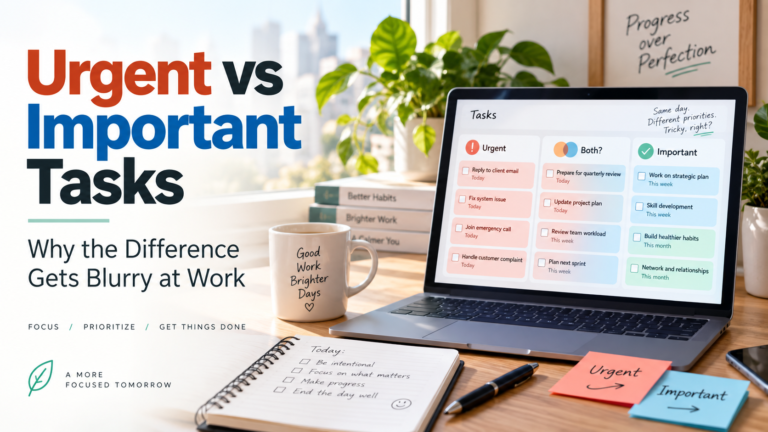
How to Create a Realistic To-Do List: Why Your List Keeps Growing Faster Than Your Day
A realistic to-do list looks like one of the simplest productivity tools imaginable.

Write down what needs to be done.
Do it.
Cross it off.
Repeat.
Yet many people experience something very different.
Monday begins with eight tasks.
By lunchtime, there are eleven.
By the end of the day, six remain.
Tuesday starts with yesterday’s six plus several new ones.
By Friday, the list has become a small archive of unfinished intentions.
This can make it feel as if the problem is poor discipline.
Maybe you need a better app.
A shorter list.
More motivation.
A stricter system.
But there is another possibility.
A realistic to-do list may be accurately recording a workload that was never realistic in the first place.
Learning how to create a realistic to-do list is therefore not only about writing fewer tasks.
It requires noticing why lists become unrealistic so easily.
A Realistic To-Do List Has Unlimited Space. Your Day Does Not.
This is the basic problem.
Adding a task takes seconds.
Completing it might take:
five minutes,
an hour,
half a day,
or several weeks.
A realistic to-do list can grow without resistance.
The day cannot.
A digital task manager will happily accept 40 tasks.
It does not stop and ask whether Thursday contains enough hours to complete them.
This creates an unusual mismatch.
The container for work is effectively unlimited.
The capacity for doing that work is not.
Adding a Task Is Almost Free
Think of the difference.
Writing:
“Update presentation”
takes three seconds.
Actually updating it may involve:
finding the latest file,
reviewing feedback,
checking numbers,
rewriting slides,
changing graphics,
asking someone a question,
waiting for an answer,
reviewing again.
A realistic to-do list records one line.
Reality contains an entire sequence of work.
That difference allows task lists to become overloaded very quickly.
A Realistic To-Do List Can Still Contain Completely Legitimate Tasks
An overloaded list does not necessarily contain unnecessary work.
Every item might genuinely matter.
Reply to client.
Finish report.
Prepare meeting.
Review contract.
Update spreadsheet.
Book appointment.
Answer colleague.
Nothing obviously belongs in the trash.
The problem may simply be that all of those legitimate tasks are competing for the same limited time.
This matters because productivity advice sometimes treats an unrealistic list as if the person has simply chosen badly.
Sometimes the work is real.
There is just too much of it.
Even a Realistic To-Do List Confuses Possibility With Capacity
A list answers:
What could I do?
But people often read it as:
What should I finish today?
Those are very different questions.
You might genuinely have 35 open tasks.
That does not mean 35 tasks belong in today’s expectations.
A realistic to-do list does not distinguish between:
available work,
possible work,
committed work,
and work that actually fits.
Once all four appear in one place, the list can begin creating pressure simply by existing.
An Accurate List Can Be an Unrealistic Daily Plan
Suppose your list contains every responsibility you currently have.
Excellent.
It is accurate.
But if you look at that same list every morning and expect to complete most of it, accuracy has turned into unrealistic planning.
This is one of the strange features of task management.
A system can represent your workload correctly while creating a misleading picture of what one day can contain.
Every Line on a Realistic To-Do List Looks Roughly Equal
Consider:
Send invoice.
Write proposal.
Prepare annual strategy.
Reply to Anna.
Review contract.
Each receives one line.
Visually, they are similar.
In time and cognitive effort, they may have almost nothing in common.
One could take two minutes.
Another could consume most of the day.
A realistic to-do list compresses very different amounts of work into identical-looking objects.
That makes workload surprisingly difficult to judge by sight.
Some “Tasks” Are Actually Projects Wearing Small Clothes
“Create website.”
“Prepare presentation.”
“Organize event.”
“Finish report.”
These look like tasks because they fit on one line.
But each may contain many decisions and activities.
A realistic to-do list can therefore appear short while hiding enormous amounts of work.
Five items do not necessarily represent a light day.
They might represent five projects.
Vague Tasks Can Stay on a List for Weeks
“Marketing.”
“Budget.”
“Research.”
“Website.”
These items are difficult to complete because it is unclear what “done” means.
They remain visible.
Move from day to day.
Acquire guilt.
Eventually the task becomes so familiar that it almost turns into part of the interface.
The problem is not necessarily laziness.
The task may simply be too vague to behave like a normal task.
Some Tasks Become Archaeological Objects
Scroll far enough down an old list and you may discover another version of yourself.
Three months ago:
Check software.
Contact supplier.
Read article.
Update document.
Are these still important?
Maybe.
Maybe not.
A realistic to-do list can preserve intentions long after the context that created them has disappeared.
Unlike memory, software does not naturally forget.
That can make a digital task system increasingly crowded with historical obligations.
Old Tasks Gain Emotional Weight
A task created today is neutral.
A task postponed seven times is different.
Now it carries a story.
“I still haven’t done this.”
The work itself may not have changed.
Its emotional meaning has.
An old task can feel heavier than a new one even when both require the same amount of time.
A realistic to-do list therefore involves more than objective workload.
It also contains accumulated psychological baggage.
Moving a Task to Tomorrow Does Not Make Tomorrow Longer
This seems obvious.
Yet task software makes movement feel almost costless.
Drag.
Drop.
Done.
Today’s schedule looks cleaner.
Tomorrow’s workload quietly grows.
If this happens repeatedly, tomorrow becomes a storage location for today’s excess.
The future is asked to absorb work that the present could not.
A Rolling Backlog Can Make Every Morning Start Behind
Monday leaves four tasks.
Tuesday begins with those four plus Tuesday’s work.
Tuesday leaves five.
Wednesday inherits them.
Soon, each morning starts with unfinished expectations from previous days.
Nothing dramatic happened.
The realistic to-do list simply accumulated faster than work could be completed.
This can make people feel permanently behind even when they are working continuously.
Unfinished Tasks Are More Visible Than Finished Work
Completed task?
Check.
Disappear.
Unexpected customer problem solved?
Perhaps it was never on the list.
Helpful conversation?
Not there.
Decision made in a meeting?
Gone.
Prevented an error?
Invisible.
Meanwhile, unfinished planned work remains on the screen.
The visual balance becomes distorted.
A realistic to-do list remembers what you failed to complete better than it remembers everything useful you actually did.
A Realistic To-Do List Can Still Make a Productive Day Look Unproductive
Imagine you planned eight tasks.
Then a serious customer issue appeared.
It took three hours.
You solved it.
At the end of the day, four planned tasks remain.
The realistic to-do list says:
50% incomplete.
Reality might say:
important problem successfully handled.
Task lists are good at tracking expected work.
They are less good at measuring unexpected value.
Knowledge Work Produces Tasks While You Are Doing Tasks
This is another reason lists grow.
You begin one task.
It creates three more.
Write report.
Need data.
Ask Finance.
Discover missing information.
Schedule call.
Update another document.
The original task did not merely consume time.
It generated new work.
Many office jobs operate this way.
Completion and task creation happen simultaneously.
Meetings Are Task Factories
A meeting starts as one calendar event.
It ends with:
send document,
check number,
contact client,
prepare draft,
review proposal.
One hour disappears from the day.
Several new tasks appear.
From the perspective of a realistic to-do list, meetings can have a double effect.
They reduce available working time while increasing the amount of work waiting to be done.
Email Is a Task-Transfer System
Someone sends:
“Could you quickly check this?”
A task disappears from their mental list.
It appears on yours.
Another message:
“Can you send me the latest version?”
Another transfer.
Workplaces continuously move tasks between people.
Your morning list may be realistic at 08:30.
By 11:00, colleagues have added their expectations to it.
Chat Makes Task Creation Even Faster
Email requires at least some ceremony.
Chat can generate requests continuously.
Quick question.
Can you check?
Do you have a minute?
Can this be done today?
Each request may be small.
Together they create a stream of additional work.
A realistic to-do list is not a closed system.
Other people can indirectly add to it throughout the day.
A Realistic List Can Become Unrealistic After You Write It
This is worth emphasizing.
You may have planned perfectly at 08:00.
Then:
a colleague calls,
a meeting runs late,
software fails,
a customer asks for something,
your manager changes a deadline.
The original list did not become foolish.
The information changed.
A realistic plan can have a very short expiration date.
Unexpected Work Usually Does Not Delete Planned Work
This is one of the central problems.
New urgent task arrives.
You do it.
What happens to the original tasks?
Usually:
nothing.
They remain.
The day gained work.
It did not gain time.
This is how perfectly reasonable days become overloaded without any single unreasonable decision.
Small Tasks Can Multiply Without Looking Dangerous
Reply.
Confirm.
Upload.
Forward.
Check.
Approve.
Individually, they look harmless.
But dozens of small tasks can consume large parts of a working day.
They also create transitions.
Open system.
Find information.
Respond.
Close.
Switch.
The total cost can be much larger than the sum of the visible actions suggests.
“Quick Tasks” Have Children
A supposedly quick task:
“Send the latest figures.”
You open the file.
One number looks wrong.
Check source.
Source needs updating.
Ask colleague.
Wait.
Receive answer.
Correct spreadsheet.
Now send figures.
The original two-minute task has produced a small family of additional work.
This is common enough that lists full of “quick things” can become surprisingly dangerous.
Administrative Side Quests Are Everywhere
Book meeting.
Need available times.
Check calendars.
One person unavailable.
Suggest another date.
Need room.
Room booked.
Change time.
Send invite.
What looks like one administrative task becomes a chain of tiny interactions.
Digital work contains enormous numbers of these side quests.
They rarely appear in the original estimate.
Digital Work Makes Task Duration Look Deceptively Small
Many modern tasks are compressed into simple labels.
Upload report.
Update website.
Send campaign.
Prepare data.
Because the physical effort appears small, the work can look small too.
There is no stack of paper.
No visible movement.
No physical object showing how much work is involved.
Everything happens on the same screen.
A five-minute task and a five-hour task may begin with exactly the same action:
open laptop.
Clicking Is Fast. Deciding Is Not.
Modern work interfaces make actions almost instantaneous.
Send.
Move.
Copy.
Publish.
But behind those clicks may be decisions:
Is this accurate?
Is this ready?
Which version?
What should be included?
Who needs to approve it?
The interface shows fast actions.
The cognitive work remains slow.
This can make digital tasks look much smaller than they actually are.
Dependencies Make Tasks Exist in Multiple States
Some tasks are not simply:
done
or
not done.
They are:
waiting for reply,
waiting for approval,
waiting for data,
waiting for colleague,
waiting for customer.
Yet they remain visible on the list.
A task can therefore occupy mental space for days while requiring only intermittent active work.
This makes lists difficult to interpret.
Ten open tasks do not necessarily mean ten tasks you can act on.
Waiting Tasks Can Become Zombie Tasks
You send the request.
Now you cannot continue.
The task remains.
Three days later:
still waiting.
A week later:
follow up.
The task is alive but not fully actionable.
These zombie tasks can accumulate until the list becomes crowded with work that is technically open but not currently possible.
Future You Is an Extremely Optimistic Employee
Tonight:
“I’ll do it tomorrow.”
Tomorrow’s version of you is imagined as:
focused,
energetic,
uninterrupted,
free from new requests.
Tomorrow arrives.
It contains another real day.
New messages.
New meetings.
New problems.
The future looked spacious because its interruptions had not happened yet.
Tomorrow Is Always Cleaner Than Today
Today’s calendar contains reality.
Tomorrow’s calendar contains assumptions.
That makes tomorrow an attractive destination for unfinished work.
There appears to be space.
But much of that space simply represents events that have not yet become visible.
Task lists repeatedly borrow from this imaginary future capacity.
An Ambitious List and a Realistic List Are Not the Same Thing
A long list can be motivational.
It can show ambition.
It can capture everything you hope to move forward.
But problems begin when an aspirational list becomes a promise.
Then every unfinished task becomes evidence of failure.
The realistic to-do list has silently changed roles.
From:
possible work
to:
expected work.
A Realistic To-Do List Can Become a Daily Contract You Never Agreed To
You wrote 14 tasks in the morning.
Nobody formally promised they would all be completed.
Yet by evening, the unchecked boxes can feel like broken commitments.
The list creates expectations through its mere existence.
That is psychologically powerful.
A planning tool can turn intentions into obligations without any external person saying a word.
Checkmarks Can Distort What Gets Done
Small task:
easy checkmark.
Large difficult task:
one checkmark after several hours.
If the realistic to-do list becomes the scoreboard, many small completions can feel better than one major piece of progress.
The tool rewards visible completion.
That can influence attention.
Task Counts Can Make Busywork Look Impressive
Completed:
18 tasks.
Sounds productive.
But what were they?
Reply.
Rename file.
Forward email.
Update status.
Meanwhile one difficult project remains untouched.
Task quantity and work value are not the same measurement.
A realistic to-do list can still encourage unrealistic interpretations of productivity.
A Master List and a Daily List Can Become Psychologically Indistinguishable
Software often allows everything to remain visible.
Today.
Upcoming.
Backlog.
Projects.
Someday.
Technically these categories may be separate.
Emotionally, the user may still see:
127 open tasks.
The system says:
organized.
The brain sees:
unfinished work.
Digital organization does not automatically create psychological separation.
Productivity Apps Can Turn Task Management Into Another Task
Update labels.
Change dates.
Reorganize projects.
Move cards.
Clean inbox.
Review backlog.
The system itself requires maintenance.
As the list grows, maintaining the representation of work can consume more time.
The task manager develops its own workload.
Beautiful Organization Can Hide Bad Arithmetic
Everything categorized.
Every task has a date.
Color-coded priorities.
Perfect dashboard.
Still:
too many hours of work.
Organization improves visibility.
It does not create capacity.
A beautifully organized impossible workload remains impossible.
Competent People Often Receive More Tasks
Finish work reliably?
People learn they can ask you.
Answer quickly?
More requests arrive.
Solve problems?
You become the person problems are sent to.
Success can increase workload.
The resulting long list may therefore reflect competence rather than poor time management.
Efficiency Can Fill Its Own Space
You automate something.
Save time.
What happens?
A new responsibility appears.
You become faster.
Expectations increase.
The realistic to-do list remains full.
Productivity gains do not necessarily produce empty calendars or short task lists.
They can increase the amount of work an organization expects to fit into the same time.
Work and Personal Tasks Share the Same Human
Client proposal.
Buy groceries.
Call dentist.
Prepare meeting.
School form.
Pay invoice.
Book appointment.
Different categories.
Same person.
A work list can appear realistic while ignoring the personal commitments using the same evening.
Time-management systems often separate areas of life more cleanly than real time does.
Calendars and To-Do Lists Measure Different Things
Calendar:
meetings and appointments.
Task list:
work to do.
A problem appears when the task list is created without noticing how much of the day the calendar has already claimed.
Eight tasks may look reasonable.
Not if six hours are already meetings.
The realistic to-do list sees work.
The calendar sees time.
The person must reconcile both.
Meetings Reduce More Than Their Scheduled Duration
09:00–10:00 meeting.
10:00–10:30 free.
10:30 another meeting.
The calendar shows 30 available minutes.
A large task may not fit psychologically or practically.
Preparation and follow-up also exist.
A day containing several hours of meetings can therefore leave surprisingly little usable task time.
Human Beings Also Need Time That Is Not a Task
Lunch.
Bathroom.
Coffee.
Walking.
Thinking.
Recovering after a difficult conversation.
Changing locations.
Looking out the window for thirty seconds.
Plans sometimes treat these as inefficiencies.
Bodies treat them as normal.
A list that assumes every unscheduled minute is available capacity can become unrealistic before the first task begins.
The Same To-Do List Can Be Realistic for One Job and Absurd for Another
Independent writer:
high control over schedule.
Customer-support manager:
constant incoming requests.
Researcher:
few large uncertain tasks.
Administrator:
many small reactive tasks.
The phrase realistic to-do list cannot mean exactly the same thing in every role.
Work environments produce very different levels of predictability.
Reactive Jobs Naturally Create Unstable Lists
Some jobs exist partly to respond.
Support.
Management.
Operations.
Healthcare.
Sales.
Customer service.
The day’s work cannot be fully known in advance because future events are part of the job.
An unfinished planned list in such an environment does not automatically mean poor planning.
The realistic to-do list may simply be competing with the actual purpose of the role.
An Unfinished List Can Become a Moral Judgment
“I should have done more.”
“I wasted the day.”
“Why can’t I keep up?”
This is where a task-management problem can become personal.
The list begins measuring character.
But the unchecked boxes do not reveal:
how much unexpected work arrived,
how long tasks actually took,
what meetings occurred,
what problems were solved,
or whether the workload ever fit.
A realistic to-do list contains data.
It does not contain the full explanation.
Sometimes the To-Do List Is Not the Problem
Suppose the week requires 50 hours of work.
You have 40.
You can use:
paper,
Notion,
Todoist,
sticky notes,
a spreadsheet.
The arithmetic does not change.
A new task system can reorganize overload.
It cannot eliminate it.
Some “to-do list problems” are capacity problems in disguise.
Repeated Carry-Over Is Information
If the same tasks move:
Monday → Tuesday → Wednesday → Thursday,
that pattern means something.
Perhaps the task is:
too large,
unclear,
dependent on someone,
less important than expected,
unpleasant,
or competing with more work than the day can contain.
Simply changing the date hides the question.
The repeated movement itself is useful evidence.
A Realistic To-Do List Is Hard Because Reality Keeps Editing It
This may be the central issue.
The realistic to-do list is written at one moment.
The day continues changing.
People send messages.
Meetings produce actions.
Tasks expand.
Information arrives.
Priorities move.
Something breaks.
The realistic to-do list is static.
Work is dynamic.
A realistic list at 08:00 may no longer describe the same reality at 14:00.
Before Looking for Another To-Do List System
It may be more revealing to look at how your existing list grows.
Where do new tasks come from?
Email?
Meetings?
Managers?
Customers?
Your own ideas?
Which tasks repeatedly move?
Which tasks are actually projects?
How many depend on other people?
Which tasks appear small but repeatedly consume more time?
Does the list grow faster than you complete it?
Those patterns describe the workload behind the list.
That can tell you more than simply changing apps.
For related reading, see How to Plan Your Day Effectively and How to Prioritize Tasks Effectively.
Frequently Asked Questions About a Realistic To-Do List
What is a realistic to-do list?
A realistic to-do list reflects the work that can reasonably compete for available time rather than treating every open responsibility as something that should necessarily be completed immediately.
Why is my to-do list always too long?
Task lists can grow because new work arrives through email, meetings and colleagues while unfinished work remains on the list. Tasks can also hide much more work than their short labels suggest.
Why does my to-do list keep growing even when I am productive?
Completing work can generate follow-up tasks, meetings can create actions and other people can continuously send new requests. Productivity does not automatically make incoming work stop.
Why do I keep moving tasks to the next day?
The workload may exceed available capacity, tasks may take longer than expected, new priorities may appear or certain tasks may repeatedly lose to more immediate work.
Why can a short to-do list still be unrealistic?
A few items can represent large projects or tasks requiring several hours. Task count alone does not show workload.
Does an unfinished to-do list mean poor time management?
Not necessarily. Unexpected work, meetings, changing priorities, task uncertainty and excessive workload can all leave planned tasks unfinished even during a productive day.
Final Thoughts
Creating a realistic to-do list sounds like a simple exercise in writing down the right number of tasks.
The real problem is more complicated.
Tasks are not equal.
Some are projects.
Some expand.
Some depend on other people.
Meetings create new ones.
Email transfers them between colleagues.
Unexpected work arrives after the list has already been written.
And unfinished tasks survive into tomorrow while completed and unexpected work often disappears from view.
This creates a strange asymmetry.
The list can grow faster than the day.
When that happens, the most useful question may not be:
“How can I become better at completing my to-do list?”
It may be:
“Why does my list keep receiving more work than my available time can absorb?”
That is often where the real problem begins.